

-
Thank You For Visiting... Please Click Here and sign up to contribute and reply to posts and download the resources.
You are using an out of date browser. It may not display this or other websites correctly.
You should upgrade or use an alternative browser.
You should upgrade or use an alternative browser.
Who makes the brightest 4x5 ground glass screens?
- Thread starter Camerashy
- Start date

- Joined
- Apr 29, 2019
- Messages
- 155
As I suspectedTrade secrets
Ian

- Joined
- Dec 19, 2017
- Messages
- 3,430
It's actually practice, experience, and judgement. I make quite a few screens a year, and have done since 2007. I've made screens for a specialist half frame35mm camera, and various sizes in between up to 15"x12". It's knowing the balance in terms of brightness and fineness, particularly with120 TLR screens and smaller.
Ian
Ian
- Joined
- Apr 29, 2019
- Messages
- 155
And a lot of patienceIt's actually practice, experience, and judgement. I make quite a few screens a year, and have done since 2007. I've made screens for a specialist half frame35mm camera, and various sizes in between up to 15"x12". It's knowing the balance in terms of brightness and fineness, particularly with120 TLR screens and smaller.
Ian
Among the makers were;
Maxwell
Beattie
Satin snow
Bosscreen
All only available 2ndhand, now.
It may sound surprising but I've read some positive reviews of cheaper and newly available ground glass screens from China, although I've never tried them myself.
No idea about the "secret of the sauce"...
I've got a Mint, 4x5 Beattie Intenscreen plus arriving any time now...
Maxwell
Beattie
Satin snow
Bosscreen
All only available 2ndhand, now.
It may sound surprising but I've read some positive reviews of cheaper and newly available ground glass screens from China, although I've never tried them myself.
No idea about the "secret of the sauce"...
I've got a Mint, 4x5 Beattie Intenscreen plus arriving any time now...
I have just made my first one, well second, the first one I tried the grit method acrylic sheet but it was not very good, so I cut another piece and then used the spray on can for frosting the glass, its works great after 3 thin coats.
Has anybody else tried this stuff I used this from Amazon
Has anybody else tried this stuff I used this from Amazon
JENOLITE Frosted Glass Spray Paint.

- Joined
- Oct 21, 2020
- Messages
- 446
I have one of your 5x4 screens and it's excellent.It's actually practice, experience, and judgement. I make quite a few screens a year, and have done since 2007. I've made screens for a specialist half frame35mm camera, and various sizes in between up to 15"x12". It's knowing the balance in terms of brightness and fineness, particularly with120 TLR screens and smaller.
Ian

- Joined
- Aug 14, 2016
- Messages
- 190
The ones which come with Chamonix cameras are decent so what
Its worth mentioning that some or all of the best screens (like the Maxwell) and others like the Tachihara screens, Chamonix and Ebony screens are actually combined ground glass and fresnel, and are a different beast compared to anything you can make yourself just by grinding or spraying some glass. The same goes for the later Hasselblad screens (Acutematte) and the Rollei equivalents.
Would this rub off eventually or if handled?I have just made my first one, well second, the first one I tried the grit method acrylic sheet but it was not very good, so I cut another piece and then used the spray on can for frosting the glass, its works great after 3 thin coats.
Has anybody else tried this stuff I used this from Amazon
JENOLITE Frosted Glass Spray Paint.
Its worth mentioning that some or all of the best screens (like the Maxwell) and others like the Tachihara screens, Chamonix and Ebony screens are actually combined ground glass and fresnel, and are a different beast compared to anything you can make yourself just by grinding or spraying some glass. The same goes for the later Hasselblad screens (Acutematte) and the Rollei equivalents.
- Joined
- Oct 21, 2020
- Messages
- 446
it's also worth mentioning that photographers have been focusing perfectly adequately on large format for just short of 200 years on screens that any of us could grind. Sure super bright is great ... but also expensive and largely unnecessary. To put it into context ... how much better would Julia Margaret Cameron's images be if she had a combined Fresnel screen?The ones which come with Chamonix cameras are decent so what
Would this rub off eventually or if handled?
Its worth mentioning that some or all of the best screens (like the Maxwell) and others like the Tachihara screens, Chamonix and Ebony screens are actually combined ground glass and fresnel, and are a different beast compared to anything you can make yourself just by grinding or spraying some glass. The same goes for the later Hasselblad screens (Acutematte) and the Rollei equivalents.
The technology is great ... but just 'nice to have' ...
- Joined
- Aug 14, 2016
- Messages
- 190
I'm sure if she was a landscape photographer with a wide lens working in very low dawn and dusk light then she'd have bitten your hand off for a fresnel.how much better would Julia Margaret Cameron's images be if she had a combined Fresnel screen?
Portraiture with normal-to-long lenses is probably the least demanding of disciplines in terms of composition and where peripheral falloff of illumination on the ground glass is barely a limiting factor. If this is all I was doing I'd be fine with a plain screen.
Last edited:
Interesting you say this because my 'new' screen is brighter but also coarser than my standard Linhof screens.Would it be true to say that a screen ground with a corse grinding paste is brighter but harder to focus with because you get a less defined image ?
So there seems to be a trade-off.
The frosted side is facing the lens so it does not get touched, and it seems very bright, even better with a Fresnel fitted.Would this rub off eventually or if handled?
- Joined
- Oct 21, 2020
- Messages
- 446
As a firm believer in 'spend money on film not gear' I think the DIY route has a lot going for it ... not least the satisfaction of making things rather than throwing money at themThe frosted side is facing the lens so it does not get touched, and it seems very bright, even better with a Fresnel fitted.

To be fair,
Space for DIY doesn't come cheap.
Tools for DIY don't come cheap.
Materials for DIY don't come cheap.
Time for DIY doesn't come cheap.
And you've got to have the skills for DIY.
So for example, rather than wasting time and money trying to make my own camera bellows, Keith can do that at Custom Bellows, and I can waste my time and money trying to take pictures instead!
Space for DIY doesn't come cheap.
Tools for DIY don't come cheap.
Materials for DIY don't come cheap.
Time for DIY doesn't come cheap.
And you've got to have the skills for DIY.
So for example, rather than wasting time and money trying to make my own camera bellows, Keith can do that at Custom Bellows, and I can waste my time and money trying to take pictures instead!
- Joined
- Dec 19, 2017
- Messages
- 3,430
Among the makers were;
Maxwell
Beattie
Satin snow
Bosscreen
All only available 2ndhand, now.
The screens I make are very similar to Satin Snow, I picked up tips from the maker. These are plain screens, Maxwell, Beattie, & Maxwell screens are combinations including fresnels, and so much brighter towards the edges and corners. Add a fresnel to a plain screen and you get very close.
I was using my Toyo last week and was shocked how dim the screen is, and it has a fresnel. It must be acid etched.
Today I set the Toyo up alongside my Wista, and was very surprised.
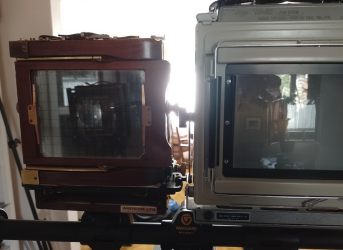
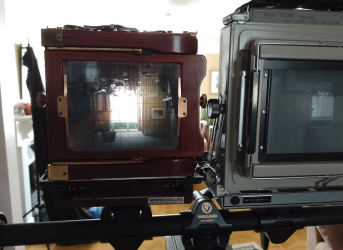
Using a spotmeter there is a fraction more than 2 stops difference in brightness (in the centre), and more importantly the Toyo screen has significantly less contrast. Both lenses are f5.6, a 150mm on the Wista, 135mm on the Toyo. Stopping the Wista lens to f11 the difference in Contrast is still very apparent.
I am shocked, but . . . . . . . . . .
Ian
- Joined
- Dec 19, 2017
- Messages
- 3,430
Ian, is it a trade off between ground glass image brightness and coarseness of the ground glass texture?
Yes, it's knowing the right balance.
After making a new screen for the Toyo, and trying a different fresnel, there was an improvement, However the spare fresnels were too large, I checked the Toyo fresnel under a loupe, and it was awful, looked very poorly cut, then I thought it might just be dirty. I washed it carefully and it was transformed. I also washed the original screen. That was the cause of the low contrast, odd because the camera is in near mint condition despite it's age.
So now it's significantly easier to focus, maybe it's unfair to compare it to the Wista's combination screen which is more like a Beattie or Maxwell screen, so I have just compared it to my Super Graphic, and it is now almost as bright.
Ian
- Joined
- Aug 14, 2016
- Messages
- 84
My 4x5 Wista screen set a pretty high bar that my self made screens have trouble (i.e fail) to meet!