Now I'm wondering how I can accurately present a digital version of a print? They are such different mediums. The suggestion is that the selection panel will be more interested in subject matter and story than technique - might even be true!
My thoughts. Since you don't know whether your image will be accepted, it's not worth creating a large print just to digitise it, unless you really want to keep it regardless of acceptance.
Do you have a flatbed film scanner? If so, either using that, or photographing the negative on a lightbox with a digital camera, are the easiest but, of course, that would also involve using software to "translate" the tonalities of the scanned file into a decent positive image for sending for assessment.
We scan or photograph our LF negs and transparencies as a matter of routine but, since we don't have a print darkroom, as I mentioned, we are printing digitally from very high resolution images to very large sized prints.
I would suggest that you have to make the decision as to how important it is to you to produce the print in the darkroom, when nowadays, nobody except us pixel-peeping nerds can tell the difference between that and a top notch "giclée" print.
We have all but given up on LF film photography as, with our D850 cameras, we can achieve a 5ft x 4ft print without straining an eyelash and up to 24" x 16" on our home printer and, as I have said before, on the right paper, indistinguishable from darkroom prints.
But, let me make one thing clear, we are not "digi-snappers". We take every bit as much time and effort to make an image as we do with LF. It was Paul Owen advertising an LF workshop in May 2005 that got us hooked. But in those days, digital was in its infancy and a 6Mpx camera was about as good as it got. Since we wanted to print big, such cameras were useful for snaps but for "the real thing" it simply had to be LF.
Even Ansel Adams expressed an interest in the possibility of digital but, I'm guessing, he, like us, would have loved the ultimate of a 5" x 4" camera with a full sized 150Mpx digital back. That is if they were affordable.
And I don't want to provoke the ire of those who still enjoy the sheer joy of a well produced darkroom print. It's just that, for us, we simply don't have the room for a wet darkroom and we can get large silver prints (up to 50") from a lab in Paris, that uses the same Lambda printer that Harman uses. The only thing we miss from our Ebony cameras is movements but, with DxO's software, we can even emulate those.
If you haven't yet looked, we have a
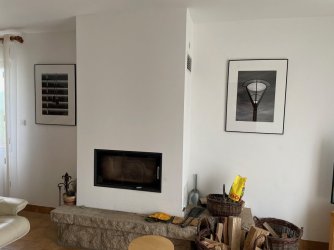
Flickr site for our work; and here is a shot of a couple of our A2 prints, framed, in our living room…



 Probably something was lost in translation there.


