What to do when a photography call for a local festival does not understand pixel-free images

AnalogueWendy

Popular Poster
Registered User
Joined
Jun 23, 2022
Messages
293
Has anyone else encountered this?
The call looks interesting and I have both large and medium format negs that will make reasonable prints, but I have to assume no-one running this call has any pre-digital photographic experience.
'1500 px is about 40cm' made me laugh but perhaps that is the size they are planning to print their digital selections . . . big mystery.
Not keen to scan my BW to have them compared with digital manipulated images and I also have a younger photographer friend who already has an image worth entering.
Any ideas?
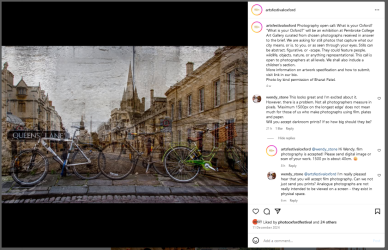
Instagram link is here. I don't want to upset them and I'm sure someone else here has run up against this.

ArtsFestivalOxfordInsta.png
 
I get the impression that they want to print the artwork which you send them.
For darkroom prints I would send the physical darkroom print to them in the post or if they are local, drop them off in person
 
Has anyone else encountered this?
The call looks interesting and I have both large and medium format negs that will make reasonable prints, but I have to assume no-one running this call has any pre-digital photographic experience.
'1500 px is about 40cm' made me laugh but perhaps that is the size they are planning to print their digital selections . . . big mystery.
Not keen to scan my BW to have them compared with digital manipulated images and I also have a younger photographer friend who already has an image worth entering.
Any ideas?
Instagram link is here. I don't want to upset them and I'm sure someone else here has run up against this.

View attachment 5049

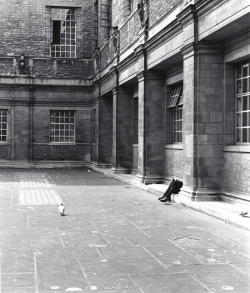
Can I send them this picture I took at Oxford:

1736455734051.png
 
They clearly want scanned or digital images - they may well be wanting to print and mount/frame all images themselves for consistency, for example, and not have to be redistributing them afterwards. I would just send them a quick phone photo of a print, making it clear that it's a phone photo of a darkroom print, and that the print already exists and is available for exhibition if they want it.

Slightly worrying though if they think 1500px prints to about 40cm though, since a digital print at that resolution (~100ppi) will look sh!te unless viewed from about a five miles away.;) Probably something was lost in translation there.
 
Has anyone else encountered this?
The call looks interesting and I have both large and medium format negs that will make reasonable prints, but I have to assume no-one running this call has any pre-digital photographic experience.
'1500 px is about 40cm' made me laugh but perhaps that is the size they are planning to print their digital selections . . . big mystery.
Not keen to scan my BW to have them compared with digital manipulated images and I also have a younger photographer friend who already has an image worth entering.
Any ideas?
Instagram link is here. I don't want to upset them and I'm sure someone else here has run up against this.

I suggest you sent them a digital image of one giant black pixel and one giant white pixel and describe it as "A transgressive commentary on monochrome imaging". You could well win...
 
Slightly worrying though if they think 1500px prints to about 40cm though, since a digital print at that resolution (~100ppi) will look sh!te unless viewed from about a five miles away.;) Probably something was lost in translation there.
My thoughts exactly. I agree that handling their own printing and not having to arrange for pick-ups after the exhibit is probably the aim (I have heard that is one of the hardest parts of organising any art exhibit).
I know for sure that I don't want anyone else printing my images! Good advice - thank you.
 
Last edited:
Ah yes. Yet another image gathering exercise, designed to attract folks who want their five minutes of fame by giving away their images for free. We get a lot of those here in France in tourism hotspots.

They don't want prints. They will accept analogue source material, as long as it is scanned because they will more than likely be using a commercial print shop to run them off.

The 1500px limit is simply to allow them to receive images by email without exceeding mailbox limits, which also means that they are looking for JPEG "quality", complete with compression artefacts.

From their reply to you, my guess is that they are planning on using something like Topaz Photo AI to resize them to 50cm x 40cm for uniformity of frame size. Something it is well capable of doing but, it's not going to give them the kind of quality LF users are used to.

I'm sorry Wendy but, if you are proud of your images, avoid this one like the plague. It will do your hard work and expertise no favours at all and I doubt if anyone looking at the exhibit will even realise what it takes to produce such high quality work. Will the prints even be credited?
 
Ah yes. Yet another image gathering exercise, designed to attract folks who want their five minutes of fame by giving away their images for free. We get a lot of those here in France in tourism hotspots.

. . .

I'm sorry Wendy but, if you are proud of your images, avoid this one like the plague. It will do your hard work and expertise no favours at all and I doubt if anyone looking at the exhibit will even realise what it takes to produce such high quality work. Will the prints even be credited?
Hmm, this is very useful advice. Yet another reason not to scan.
Thank you.
 
Last edited:
These figures suggest that the images will be projected, not printed and framed.
Here's a reference from more-or -less the first thing I discovered.
 
These figures suggest that the images will be projected, not printed and framed.

If you follow through to the main website, you will see they are intended for display in a gallery.

“What is your Oxford?” will be an exhibition at Pembroke College Art Gallery curated from chosen photographs received in answer to the brief.
 
Last edited:
We may have to remain baffled. I have come across photographers (even members of the RPS) who don't quite grasp the different requirements for different media – digital projection, digital printing for exhibition and printing for publication. It's possible that the Oxford organiser is one of them.
Obviously, Wendy's (excellent) "real" prints don't fit into any of these categories.
It's also possible that these images are being requested for the selection process only and not for the exhibition-ready work itself. Many organisations do this. It avoids storing and handling valuable original works and, in my experience, dealing with mountains of bubble-wrap.
 
. . .
It's also possible that these images are being requested for the selection process only and not for the exhibition-ready work itself. Many organisations do this. It avoids storing and handling valuable original works and, in my experience, dealing with mountains of bubble-wrap.
I am keeping an open mind for this possibility. Let's see whether I receive a response to my email.
 
It's also possible that these images are being requested for the selection process only and not for the exhibition-ready work itself

I must admit to not having thought of that option. What comes to my mind is, if that is the case, how would they receive the finished prints? I doubt if they would want finished and matted prints sent by mail, so that would leave them with the idea of receiving large files, which would, almost certainly be inkjet printed by them.

Now, we print on a Canon Pro 1000 A2 printer, which gives us astounding results in a true B&W mode that, on Canson Baryta paper has fooled more than a few into believing that they are darkroom prints. One can but hope.
 
Last edited:
I belong to a group that has online selection. After the selection process, the “winners” are given a date, time and place for delivering finished and framed prints, together with details of the hanging devices to fix to the frames. All galleries seem to have their own idiosyncrasies in hanging. It seems to work.
In practice, the sequence is a little bit different, but this seems a likely scenario. Photographers make and frame their own prints in this case.
All this is pure speculation, to explain the unusual requirements that Wendy encountered. It may be entirely wrong.
 
Ah yes. Yet another image gathering exercise, designed to attract folks who want their five minutes of fame by giving away their images for free. We get a lot of those here in France in tourism hotspots.

This, tragically, is more true than not, more often than not.
 
Why not - you will have to explain why you 'have a special connection to the city'.

I guess I'm disqualified then. I was just a tourist passing by an saw the bird, the legs, and the lady looking down from the window above. It was a moment of photographic whimsy.
 
Good news!
1) The arts festival co-ordinator replied to my email
2) She may even be an analogue photographer herself.
3) @David M had the closest suggestion. They are using email submissions for their selection panel to see the work (and I'm sure @Joanna Carter is right about that being the pixel size limitation)
4) Work will be credited to the photographers
5) Suggestion is that I scan or photograph an analogue print and send it by email

Thank you for all the advice here - it helped me to ask the right questions and receive a helpful response so I'm grateful to you all.

Now I'm wondering how I can accurately present a digital version of a print? They are such different mediums. The suggestion is that the selection panel will be more interested in subject matter and story than technique - might even be true!

I'm unlikely to have a large format submission ready in time, but I will submit something. I'd better warm up the darkroom and do some work :D
 
Now I'm wondering how I can accurately present a digital version of a print? They are such different mediums. The suggestion is that the selection panel will be more interested in subject matter and story than technique - might even be true!

My thoughts. Since you don't know whether your image will be accepted, it's not worth creating a large print just to digitise it, unless you really want to keep it regardless of acceptance.

Do you have a flatbed film scanner? If so, either using that, or photographing the negative on a lightbox with a digital camera, are the easiest but, of course, that would also involve using software to "translate" the tonalities of the scanned file into a decent positive image for sending for assessment.

We scan or photograph our LF negs and transparencies as a matter of routine but, since we don't have a print darkroom, as I mentioned, we are printing digitally from very high resolution images to very large sized prints.

I would suggest that you have to make the decision as to how important it is to you to produce the print in the darkroom, when nowadays, nobody except us pixel-peeping nerds can tell the difference between that and a top notch "giclée" print.

We have all but given up on LF film photography as, with our D850 cameras, we can achieve a 5ft x 4ft print without straining an eyelash and up to 24" x 16" on our home printer and, as I have said before, on the right paper, indistinguishable from darkroom prints.

But, let me make one thing clear, we are not "digi-snappers". We take every bit as much time and effort to make an image as we do with LF. It was Paul Owen advertising an LF workshop in May 2005 that got us hooked. But in those days, digital was in its infancy and a 6Mpx camera was about as good as it got. Since we wanted to print big, such cameras were useful for snaps but for "the real thing" it simply had to be LF.

Even Ansel Adams expressed an interest in the possibility of digital but, I'm guessing, he, like us, would have loved the ultimate of a 5" x 4" camera with a full sized 150Mpx digital back. That is if they were affordable.

And I don't want to provoke the ire of those who still enjoy the sheer joy of a well produced darkroom print. It's just that, for us, we simply don't have the room for a wet darkroom and we can get large silver prints (up to 50") from a lab in Paris, that uses the same Lambda printer that Harman uses. The only thing we miss from our Ebony cameras is movements but, with DxO's software, we can even emulate those.

If you haven't yet looked, we have a Flickr site for our work; and here is a shot of a couple of our A2 prints, framed, in our living room…
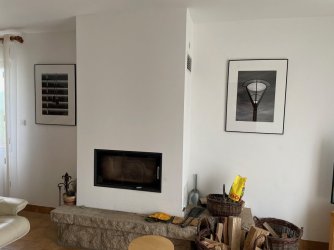
IMG_1357.JPG
 
Last edited:
Thank you again, @Joanna Carter.
I can, and sometimes do, scan negatives. I really don't enjoy scanning and have only just realised today that there is no need to restrict myself to 'darkroom' size if I scan and invest in digital prints. A really good exhibition by our local photographic society is making me think again about scale.

You are undoubtedly right that no-one except me is bothered about how I create images. I decided back in 2018 to go backwards rather than forwards with photographic technology and I am enjoying every bit of it - and then I saw those huge prints today. I know I can do both and I should.

We are so lucky to have access to ALL the options!
 
Last edited:
Back
Top