Unusual lens, anyone come across this before?

Nas

Popular Poster
Registered User
Joined
Aug 22, 2021
Messages
496
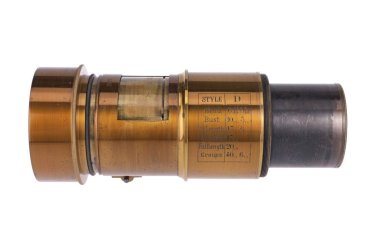
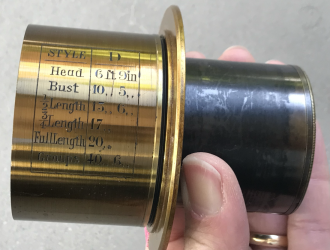
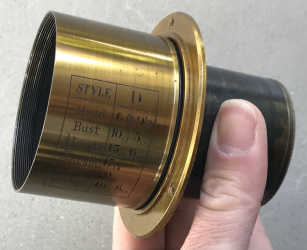
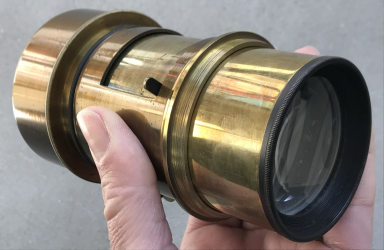
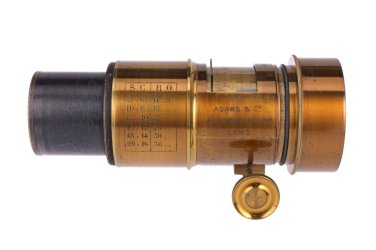
Has anyone come across one of these lenses before? The engraving on the side reads: Adams & Co. Augmentagraph lens. From the markings on the side it covers up to 20x16.
s-l1600.jpg
s-l1600-2.jpg
I can find next to nothing in terms of info online except for this:

Catalogue Page from Exhibition Catalogue: 1895 Fortieth Annual Exhibition of the Royal Photographic Society​

showing (E95A021) Exhibit no. 476: Augmentagraph Lens by Adams & Co. ()

Screenshot 2025-01-28 at 8.11.14 PM.png

The 12x10 camera I bought last month came from a museum and inside the camera case was a label (I assume the label was displayed with the camera at the museum) which mentioned this Augmentagraph lens but only the flange came with the camera. This is the same flange I asked for help identifying in an older forum post, it has an R engraved on it. By sheer luck, I stumbled across this lens a week ago on the well known auction site and I was the winning bidder. This lens came from the same seller as the camera so I'm certain they were both together at the museum.

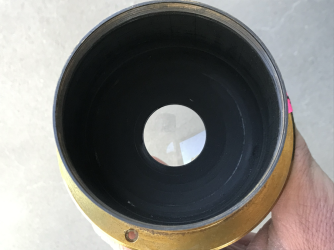
What I'm trying to work out is what the aperture numbers relate to in today's measurements. I can't believe this is an f5 lens and that's the lowest number on the scale. I mounted this lens on my 12x10 camera with a subject around 10 feet away and the bellows extension was approx 22 inches which matches the markings on the side. The black rear section can be removed but the strange part is there's a fixed piece of black metal inside, between the middle and rear lens groups and the hole in the middle is much smaller than with the aperture blades fully open which probably makes this lens at least 2 stops slower.
Removing the black rear section doesn't work because the remaining thread doesn't match the thread on the flange so the rear group is clearly needed. If anyone has come across one of these lenses before I'm keen to learn more about it.
 
Looks interesting. If my maths is correct (thin lens formula) that makes it a 470mm or 18.6 inch lens. Equivalent in 35mm terms to a 50mm using 10x12 film. Correct me anyone if I have got the formula the wrong way round. If it's an F/5 lens the aperture should be around 90mm.
 
  • Like
Reactions: Nas
As Adams & Co didn't make lenses, so the question is who did make this one ? The company bought in lenses which were engraved with the Adams & Co name in-house.

It reminds me of an early Ross Telephoto, which actually looks roughly similar. Coverage is for close portraits, and that statement "without using an extra long focus camera" and then "portrait lens with a complimentary one attached behind it" indicates it's a telephoto design.
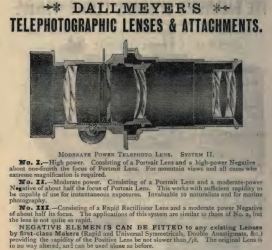
J. H. Dallmeyer invented the Telephoto lens, he had worked for Andrew Roos & married a daughter. While I initially thought Ross, I'm now fairly confident it's most likely a re-badged Dallmeyer Telephotographic lens. I would add the description matched a Dallmeyer advert, as does a cross-section of the design.

1738175179015.png

Ian
 
  • Like
Reactions: Nas
Very good, Ian. I think you may have cracked it. This cross section matches my lens and it's definitely a telephoto on my 12x10 when I compared it to my Dallmeyer 4D. For example, if the 4D was giving me a rough equivalent angle of view of a 35mm lens on 35mm format, this Adams & Co. lens was pulling everything in like it was an 85mm equivalent on 35mm format, possibly longer. It will make nice portraits outside when we get sunnier weather.

What I can't tell is which of the 3 Negative lenses I have attached to the back of mine. There are no markings to be found anywhere. It would be great if I could find the other Negative attachments to compare. Do you have this Dallmeyer Telephotographic lens in your collection? Do you have any pictures of what the outside of the Dallmeyer looked like? I'm curious to see how the engravings of plate size and bellows extension changed for the different attachments.

After a bit more research I came across this Dallmeyer lens catalogue which explains a lot of detail about the telephoto attachment lenses (last few pages of the PDF). I still can't work out which attachment I have, if indeed mine was made by Dallmeyer. None of the ones listed cover 20x16. Could mine be a later version or made by someone else using the same design? In any case, they are very slow in terms of aperture. We're talking f39 territory. I think that rules out using paper negative indoors or anywhere but full sun.
 
Last edited:
Here are more pictures for reference. The whole rear section comes off including the flange. The thread just behind the aperture control on the main body is different to the flange thread which leads me to believe this lens was not intended to be used with only the front two groups unless there was a specific flange for that. With only the front two groups the lens does project a much smaller image circle around quarter plate.

Comparing this to pictures of the Dallmeyer equivalent, this looks much more sophisticated with the brass cylinder being part of the telephoto attachment.

tempImageDe9HjP.pngtempImageWMu2aF.pngtempImageLNYkbk.pngtempImage4058Ws.png
 
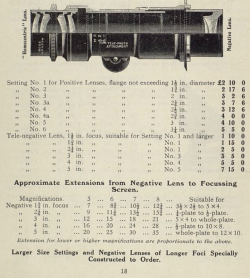
I'm on the fence, maybe far more likely Ross rather than Dallmeyer. Page 18 of the Rpss 1922 catalogue.

1738244515116.png

Later in the catalogue pages 46 &47 Ross list 2 Adams & Co cameras, andI'm fairly sure that some of the other cameras are also made by Adams & Co. The link is close as Adams & Co's own adverts list their cameras with Ross and Zeiss Patent lenses. The Zeiss Patent Protar& Tessar lenses would have been made by Ross.

The last line on page 18 above is probably the key here.

Ian
 
Very good, Ian. I think you're on the right track with this one. I'm curious about the word "Augmentagraph", it's not a term I've come across before. Maybe only Adams & Co used the word and their branded lenses are not as common as others.
Something curious about my lens is the flange looks to have been taken from something else. There's an R logo engraved which sits in an odd position when the lens is mounted. I would expect it to be in the middle of either the top or bottom of the lens. Also, something Wendy noticed is there aren't many threads on the flange and only three screw holes for a lens weighing 1.2KG. A custom order is feeling more likely to me.
 
If you intend to shoot barrel lenses its well worth buying a thread guage (threads are often Whitworth) and small but reasonably powerful magnifying glass. The only thing to be really aware of is that often threads have the outer edge worn down very slightly, so specifying the overall diameter from a measurement can result in a slightly tight fit. In theory (I haven't as yet tried this) it should now be possible to print a flange including the thread.
 
If you intend to shoot barrel lenses its well worth buying a thread guage (threads are often Whitworth) and small but reasonably powerful magnifying glass. The only thing to be really aware of is that often threads have the outer edge worn down very slightly, so specifying the overall diameter from a measurement can result in a slightly tight fit. In theory (I haven't as yet tried this) it should now be possible to print a flange including the thread.
Thanks. A friend of mine has 3D printed me a lens board with threaded flange for a different lens and it's very sturdy.
 
Thanks. A friend of mine has 3D printed me a lens board with threaded flange for a different lens and it's very sturdy.
Oddly enough I was talking to someone I know who has a 3D printer about doing just this on Friday. Will look into it further myself.
 
Oddly enough I was talking to someone I know who has a 3D printer about doing just this on Friday. Will look into it further myself.
In the past I've ordered custom 3D printed lens boards from Steve at Chroma Camera in Liverpool and his work has been excellent. Simon Forster of Forster UK also 3D prints custom lens boards as well as lens caps.
 
Back
Top