Install the app
How to install the app on iOS
Follow along with the video below to see how to install our site as a web app on your home screen.

Note: This feature currently requires accessing the site using the built-in Safari browser.
-
Thank You For Visiting... Please Click Here and sign up to contribute and reply to posts and download the resources.
You are using an out of date browser. It may not display this or other websites correctly.
You should upgrade or use an alternative browser.
You should upgrade or use an alternative browser.
Show Us Your Camera
- Thread starter Ian-Barber
- Start date


- Joined
- Sep 5, 2021
- Messages
- 131
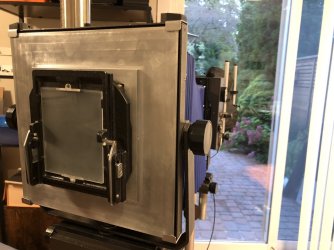
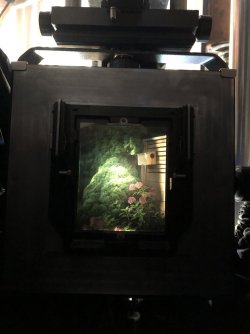
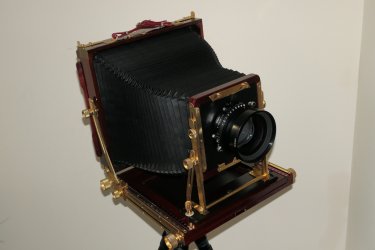
Maybe that lens does need an introduction!My new toys.
The lens needs no introduction. The camera is a Horseman L45.
View attachment 4681View attachment 4682

- Joined
- Jun 23, 2022
- Messages
- 293
That looks like a lot of future fun!
- Joined
- Aug 29, 2020
- Messages
- 1,381
This looks to be a great (re)entry into the world of large format.
What is wonderful about these 5x4 cameras is that they are all able to deliver terrific results. The differences between a camera like this, and one costing multiple thousands of pounds, principally involve convenience, not quality.
I started out on a Cambo monorail back when dinosaurs roamed the earth, and it produced great images. I look forward to seeing wondrous images produced on the Little Red Kite!
Last edited:

- Joined
- Dec 19, 2017
- Messages
- 3,567
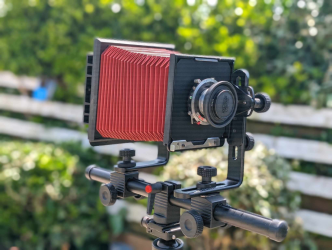
Cambo Cadet 5x4 - Now named the little red kite
The rail is not that long, and the lens is a good distance above it. While I only used mine over one long weekend in Cornwall I was surprise how easy it was to use and carry when on quite a long trek.
Ian
I posted this on the US site but it might be of interest here too:
I've been working on the idea of a 'step and repeat' camera for quite some time and finally got my act together and paid out sufficient to at least get the project rolling forward. The Arca monolith section allows the Sony EVF camera to be moved vertically and horizontally and so to sample different sections of a larger format imge projected by the lens being used. In my case the lenses I have are mostly fairly early Grubb (1860s) with some later Grubbs, Dallmeyers and TTH too. The advantage for me is that the result is straight to digital, so there is no film cost for testing these lenses and with refinement the camera should be relativle portable and might be usable in the field if the conditions allow.
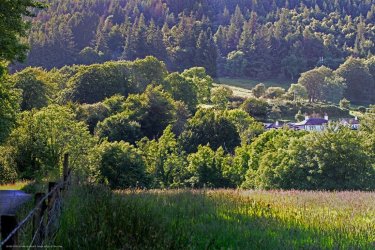
Here's my second attempt - a 9 image stitch of ~150-200MPixel equivalence with a ~6x9 or 1/4 plate covered area. It was taken on a lens similar to the one used as subject matter by abvailable light and is not perfect but shows the potential.
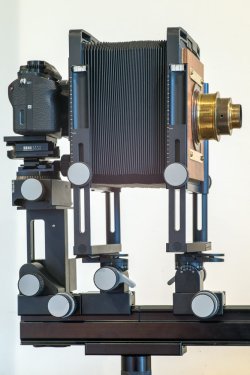
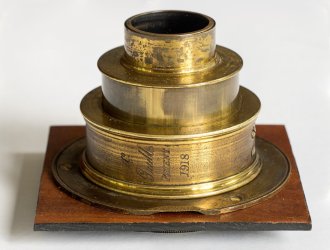
I've been working on the idea of a 'step and repeat' camera for quite some time and finally got my act together and paid out sufficient to at least get the project rolling forward. The Arca monolith section allows the Sony EVF camera to be moved vertically and horizontally and so to sample different sections of a larger format imge projected by the lens being used. In my case the lenses I have are mostly fairly early Grubb (1860s) with some later Grubbs, Dallmeyers and TTH too. The advantage for me is that the result is straight to digital, so there is no film cost for testing these lenses and with refinement the camera should be relativle portable and might be usable in the field if the conditions allow.
Here's my second attempt - a 9 image stitch of ~150-200MPixel equivalence with a ~6x9 or 1/4 plate covered area. It was taken on a lens similar to the one used as subject matter by abvailable light and is not perfect but shows the potential.

- Joined
- May 22, 2024
- Messages
- 12
Here is my “pride and joy”. I'm lucky to have a 150 and 75-mm lens and some nice backs. Including an old Polaroid 4x5, sadly no more film, though :-(Post some images of your camera(s)
I shoot a lot of film and digital on it (PhaseOne and Hasselblad backs.)
Attachments


- Joined
- May 22, 2024
- Messages
- 12
That looks excellent! I have a Gigapan robotic head, which allows very precise "step and repeat" actions. It works very well. I have shot images at close to 3 Gigapixels. A pixel peeker’s dream!I posted this on the US site but it might be of interest here too:
I've been working on the idea of a 'step and repeat' camera for quite some time and finally got my act together and paid out sufficient to at least get the project rolling forward. The Arca monolith section allows the Sony EVF camera to be moved vertically and horizontally and so to sample different sections of a larger format imge projected by the lens being used. In my case the lenses I have are mostly fairly early Grubb (1860s) with some later Grubbs, Dallmeyers and TTH too. The advantage for me is that the result is straight to digital, so there is no film cost for testing these lenses and with refinement the camera should be relativle portable and might be usable in the field if the conditions allow.
Here's my second attempt - a 9 image stitch of ~150-200MPixel equivalence with a ~6x9 or 1/4 plate covered area. It was taken on a lens similar to the one used as subject matter by abvailable light and is not perfect but shows the potential.
- Joined
- Oct 17, 2023
- Messages
- 432
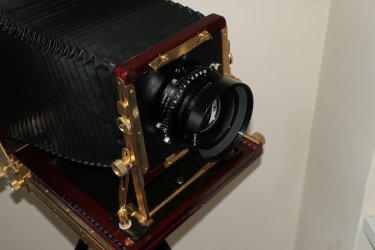
Here is my new (to me) Nikon W 360 f6.5 fitted to the pride of my fleet, a Tachihara 8x10 field stand.
Once again, the sheer size and weight of the lens surprised me.
A small price to pay for getting a good size image circle.
Once again, the sheer size and weight of the lens surprised me.
A small price to pay for getting a good size image circle.
- Joined
- Oct 17, 2023
- Messages
- 432
Fortunately, at infinity, the bellows extension is minimal so the front standard does not down sag under the weight.Presumably the expectation was that they’d mostly be used on tank-like all-metal monorail cameras in a studio and mounted on something very sturdy.
- Joined
- Aug 29, 2020
- Messages
- 1,381
Presumably the expectation was that they’d mostly be used on tank-like all-metal monorail cameras in a studio and mounted on something very sturdy.
Yes, if you look at our elders and what they used in the field, you don't see a lot of f/5.6 optics. There was a tendency to slower, and therefore smaller, lenses.
In my stable of toys I have several Kodak Ektars and Artars none of which are faster than f/6.8, for example. Well, I do have a 127mm f/4.7 Ektar but that only covers 4x5.
So our current embarrassment of riches of fast large format lenses, comes at the cost of size and weight.
- Joined
- Oct 17, 2023
- Messages
- 432
Well, I did not do much research on the lens as it was kind of an impulse buy.
Whilst I have not used it in anger yet, it's not vastly heavier than my 240 app symmar.
I wanted lots of room for shifts/tilts/rise and fall and the Nikon 360 delivers this in spades.
An extra 500g will make no difference to my hobby..
Whilst I have not used it in anger yet, it's not vastly heavier than my 240 app symmar.
I wanted lots of room for shifts/tilts/rise and fall and the Nikon 360 delivers this in spades.
An extra 500g will make no difference to my hobby..
What surprises me most about older camera gear is the spindly individual tripod legs that fitted into the base of the camera. They are tricky to attach and deploy, although they can be surprisingly stable once that’s done. Without a tripod head as such, the only way to level the camera was by adjusting each leg in turn.
Old photographs of them in action show that they were generally spread rather wide too. Don’t know why. On the other hand, they do pack up into a remarkably compact and light bundle.
The Nikkor 360mm will cover 11x14 - almost certainly more than the movements on many 10x8 field cameras will provide
Old photographs of them in action show that they were generally spread rather wide too. Don’t know why. On the other hand, they do pack up into a remarkably compact and light bundle.
The Nikkor 360mm will cover 11x14 - almost certainly more than the movements on many 10x8 field cameras will provide
- Joined
- Aug 9, 2016
- Messages
- 855
Frank Meadow Sutcliffe told a nice story about one of his sets of tripod legs. They were so heavy that he got into the habit of leaving them at outlying farms, to save him carrying them everywhere. Then, one day, he forgot where he'd left them. He knocked on several doors and asked "Have you seen my legs ? ", before eventually he got lucky. He was invited into a cottage and the owner pointed to a petticoat that was drying in front of the fire, and said, "If you lift that petticoat up I think you will find that your legs are underneath it." Sutcliffe's tripod legs were being used as a clothes horse.
Joe Carrigan
Registered User
- Joined
- Jun 6, 2024
- Messages
- 7
Here is my favouritePost some images of your camera(s)
a Mentor Panorama 1 18x24cm with focal no plane shutter plus a 4x5 reducing back i had made. it also has adapters for my linhof T3 4x5 and 6x9 lenses, plus a sliding adapter back for my Leaf Aptus 75 digital back - woohoo!