Hi, from the Lake District.

It might be being harsh but the quality of all the images you have ever posted here on this Forum has been extremely poor, and that's not been down to scan quality, it's everything from composition, technique to final output. I've taught photography at various levels for over 50 years and to be frank and honest the images you post are amongst the worst I've ever seen, and then based on your claims of experience and insight are even worse.

I call a spade a spade, but you don't get near any ball-park in terms of acceptable LF image quality. It's time other Forum members realised this.

Ian

Ian -

I cannot fathom what level of unhappiness causes your periodic outbursts of vitriol. I have been nothing but polite and kind to everyone here, including you. Perhaps your life circumstances are unpleasant. Perhaps you find your own work wanting. Perhaps you're just a generally mean and unpleasant person. I've no idea. But I am certain - without qualification - that I am not your problem.

As to my images, I will let them speak for themselves to all here. A sampling of my 50 years work can be found here in all formats from 35mm to 5x4:

https://www.tundraware.com/Photography/MyPhotographs/Silver/

I wish you the best of the New Year in any case ...
 
Last edited:
I can’t find any images posted by Richard. He’s only just bought his camera. Have I got something wrong here?

It was directed at me, as it has been in the past ... for no apparent reason. I am led to understand that Ian went through sad personal circumstances within the last year or so and perhaps the turning of the New Year somehow amplified this, I don't know.
 
Last edited:
I can’t find any images posted by Richard. He’s only just bought his camera. Have I got something wrong here?
Hi David, thanks for that. The comment comes as a complete mystery to me as well - not least because this was my introductory post and I haven't yet submitted any images to the Forum.

Richard
 
Hi David, thanks for that. The comment comes as a complete mystery to me as well - not least because this was my introductory post and I haven't yet submitted any images to the Forum.

Richard

It wasn't directed at you. Ian periodically feels the need to tell the world he doesn't like my work. Why, I don't know, but this has been a theme now- and then here. It's best just ignored.
 
Gentlemen, please… No fighting in the War Room!

Perhaps I should create a new post, but a Happy New Year to all.
 
Ouch! Where did that come from..?

Richard

Definitely not you, and to be frank people need to realise what or who is thronobulax . His posts don't match his extremely poor images.

No one on this website has seen even a half decent image from him, but hang on we regularly see far higher quality images from, and I think that says it all new members

Ian

<Redacted for civility>

I have made a sampling of my work available for all to see and comment as they see fit, though I realize that my failure to follow the One True Path Of The Academy (tm) and failure to have an "Artist's Statement' forever relegate me to your artistic dustbin. Sadly, I shall contribute here as I see fit and feel I can add value to the conversations. You're just going to have to live with it ...
 
Last edited:
People regularly post sub-optimal images here, to illustrate a point or ask for advice. As far as I know, there is no minimum requirement on members other than an interest in large format photography.

This digression illustrates an interesting question: what is “quality”?
I recall that the Royal Photographic Society (still a force in the world) declined to exhibit work by Edward Weston (who needs no introduction here) because they had a different view of what an image should be.

Would it be possible, for the benefit of the rest of us, to open a new thread and debate what parameters both sides see as constituting excellence.

I have in mind here the Guardian column “Dining across the divide” where two people with opposing views take a meal (paid for by the newspaper) together and often make interesting discoveries.
It might indeed be interesting but I doubt it would be very productive.

That's because all images are "sub-optimal" to someone. I recall being flogged because I dared to let a shadow go to full black even though detail was present in the negative. This was by intent in the printing process. That response was an arts school reaction to an image rather than an artistic judgment. Upon restoring the shadow detail, all the complaints ceased ... even though I much preferred the original image on its structural merits. The point is that what resonates with one person will be "sub-optimal" to another and that's not about quality. It's about how different individuals respond to art.

It is one thing to note scratches in a negative, things clearly out of focus (unless you're Man Ray), low contrast images due to underexposure ("But I used the box ASA!") and so forth. These are obvious technical failures than should be noted an corrected. But someone choking about whether or not all tones are present in all images, whether the rule of thirds is strictly observed, whether sufficient foreground tilt was used, all without understanding the intent of the object as art is just entirely silly. By that measure, as you note, the Westons, Brassai, Atget, Strand, and even St. Ansel would be canceled from the body of modern photography. Demanding perfect technical fidelity for all images without exception is akin to listening to some Jazz guitarist play every scale in every mode and never expressing anything interesting.

P.S. I partly blame the arts schools for producing graduates who consistently create dull and unimaginative work. Among all the photographers I admire - both famous and people I know personally - I've yet to meet one who does great work who went to such an institution. The photographers I've known who have matriculated through, say, an MFA, tend to be good house painters but boring artistically. That is, they usually do fine commercial work, but have very little expressive to say. I'm sure there are exceptions, I've just never encountered one. Most of the arts school grads I know are either working as photographer's assistants in a commercial setting, are themselves doing strictly commercial work (house painting), or have left the field entirely. I'd suggest that's because the people who teach in such schools are basically technicians and almost never good artists, but my sample size is small and I'm willing to be proven wrong.
 
Last edited:
A few years ago, I did an MA in photography. I already had a qualification in Industrial Design, but that was not considered to be of degree level, like all arts qualifications at the time in the UK. I believe the system in the US differs. The aim of arts courses at the time was to produce graduates who could practice professionally. Medicine has a similar aim. Literature, oddly, does not.
When it was decided to upgrade arts qualifications to degree level, it was felt that there was insufficient academic content to existing curricula. More history was added (a good thing in my view) and some kind of theoretical structure was added. Not the practical theory of light and chemistry, but some sort of mental framework on which wider discussions could be hung. So far, this seems reasonable.
In my view, the choice of politicised (in the wider sense) writing as a model was a mistake. I'm not alone in this, but neither is the other side. It's called Critical Theory, but as nothing falsifiable is involved, it can't legitimately be called a theory and it's notably resistant to criticism of itself. It's possible that I am expressing this clumsily.
Nowadays, no student body of work is compete without an essay justifying its existence and practice. All too often, it seems to me, the essay has primacy over the images. None of this should be taken to mean that photographers should not be thinkers and writers.
The digital revolution has changed things considerably. It's possible that numerically, more photographic essays are published by "influencers" than any other group, ourselves included.

I'd welcome the discussion on quality, although I'm not offering to pay for lunch.
 
The biggest difference - as best as I can determine - between the UK and US systems is that your system openly declares its intent to build commercial practitioners. I applaud this because photography is a fine vocation and "house painters" are in far greater demand that artists. The US system maintains the pretense that it is teaching people to become artists and this is demonstrable nonsense, at least thus far as I have encountered the graduates of the US system.

In taking your MA, I am curious though, how many of your professors were first class artists in their own right? Was there any emphasis on art standing on its own merits, I wonder?

As to Critical Theory, I fully share your horror of this trash. It is rooted in the linguistic philosophers of the last century as amplified by the existentialists, deconstructionists, and post modernists. It is a full on assault on truth, beauty and objective standards. It's essentially a form of intellectual self pleasuring that has absolutely no correlation to reality or meaning. It has now come into its fullness as science itself is discarded in favor of "how I feel", "how i identify", and other forms of mental poison. Having destroyed literature, music, and art, the Theory schools are now assaulting the very essence of being human.

As you say, it's a non-falsifiable system of "thinking" - which means it is unapproachable by reason or scientific method. The execrable academy that peddles this stuff is using it to indoctrinate youth rather than educate them, They effectively wish to produce intellectual slaves for the elites who want to run things. One need only look at what's happened in recent years to see how pervasive this cancer has metastasized in a full on assault on our minds, spirits, and indeed, our very physical beings.

I would commend a couple of things to your attention in matters of Critical Theory. First there is this - a scientist unmasks the complete fraud that it all is. It's hilarious but also depressing:


More directly related to art is Roger Kimball's book "The Rape Of The Masters". It should be required reading for anyone interested in art or culture. Kimball - who may be the last good art critic working in the US - takes us through a number of historically important paintings and explains just why they are important. He then reads us in on just what the academic Theory bunch has to say about these works. The book is, by turn, hilarious, tragic, and infuriating.

Our culture is run by evil people who've educated the masses to be unquestioning fools. Soon enough, the barbarians will be at the gate again...
 
I'm not sure I concur with everything you say, but I do with the gist of it.
The barbarians are always there, but they change their spots.
We ourselves are of out own time. We are tomorrow's fuddy-duddies. The only thing we can be certain of is uncertainty.

There are two examples I'd like to offer of changes in thinking. Firstly, the well-known case of the Impressionists. Not much need to say more. My second example is Japanese woodcuts. They were held in so little regard that they were used as packing for exported porcelain. Now they are highly valued.

I should add that when I expounded my views to a friend he did say that at least it got people away from endless discussions on burning in the sky a bit more and made them think. As we have illustrated here.
 
Ouch! Where did that come from..?

Richard

My comments were harsh but needed, and as I said before not aimed at you.

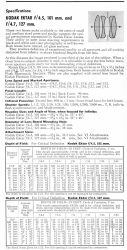
The problem is the 127mm Ektar is a Tessar type design and Kodak sold it for the 3¼ x 4¼ Quarter plate Speed Graphic, where it does have room for movements. Press photographers used it on the 5x4 Speed Graphics, but they never used movements. So it needs careful use.

1672687633062.png

Tessar & type lenses have a large circle of illumination, and it is significantly larger than the Image Circle which is the area of acceptable sharpness. Usually the front rim and filter thread cause vignetting before you run into the unsharp area. However, the 127mm Ektar uses a push on filter and doesn't vignette on Pacemaker Graphics. I have one so that's experience :D

It is also worth mentioning that LF Tessar and type lens sharpness drops off quickly at the edges and corners as you open up the aperture, they are best at f22, with a 135mm Tessar there's just detectable drop in edge sharpness at f16, the 127mm is that touch softer.

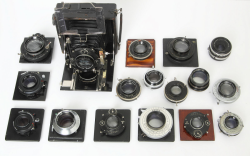
I have and use a lot of Tessar & type lenses so again I;m talking from experience.

1672688470040.png

Ian
 
Back
Top