- Joined
- Dec 19, 2017
- Messages
- 3,356
Looking through various publications etc it apparent thatthe Dallmeyer Portrait lenses have been re-designed at least twice. Also the designation letters for some series changed.
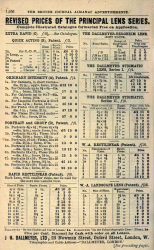
Below is from a Dallmeyer advert, and then some notes on the different series.
_________________________________________________________________________________________________
When required for standing figures, card size, a stop must be used to obtain sufficient flatness of field. In this condition their performance, as regards time of exposure, definition, and distance from subject, is about equal to that at Nos. 1 B and 2 B Lenses.
The smaller Miniature Lens, suitable for quick locket portraits, vignette heads, &c., works in about the some time as No. 2 C Lens.
Quick-Acting Portrait I.enses. - Nos 1 B and 2 B are especially constructed for card portraits. They were introduced November, 1860. and are now so extensively known and used by photographers in all parts of the world that further comment. is superfluous.. Suffice it to state that of the above two Lenses the larger, or 2 B, is always to be preferred for card portraits, where space admits of its use. No. 1 B requires a distance of from 12 to 13 feet, and No. 2 B from 18 to 19 feet. for a standing figure. With open aperture these two Lenses require the some exposure. Since, however, No. 2 B covers a larger plate it can he used with a larger aperture for standing figures, cord size. Hence, for this purpose, it becomes practically the quicker acting Lens of the two. The increased distance also between Object and Lens tends to better perspective in the resulting picture.
For those photographers who wish to use a longer focus lens than No. 1 B, but who have not sufficient. length of gallery for No. 2 B, No. 1 B (long) has been constructed, requiring a distance of from 14 to 15 feet. This Lens is :a little slower in action than a No. 1 B, both with open aperture; but for standing figures it produces better results.
The above Lenses and the New Stereoscopic Lens, introduced at the some time, are the only ones now manufactured of the old, or Petzval construction ;all other Portrait Lenses of larger dimensions and of the old form being superseded by J. H. Dallmeyer’s
New Patent Portrait Lenses - These Lenses are superior to the old or Petzval form in sharpness of definition, freedom from distortion and flare, and equality of illumination; whilst, in addition to this, they afford the means, by the simple turn of a screw, of obtaining greater equality or depth of definition. The construction of the Lens is such that, with the posterior cell of the back combination screwed home, the index pointing zero,it produces the sharpest possible picture of objects situated in one plane. Then, by unscrewing: the posterior call e turn, or parts of a turn, of screw, the previous intensely sharp definition becomes modified, i.e., the contrast of excessive sharpness in one plane, compared with greet wont of sharpness in other planes. is modified, ‘producing the impression of a general distribution or depth of focus; and. this in exact proportion to the amount of unscrewing. Nothing has been sacrificed in securing this new pawn", and it can be use or not, at the wire oi the operator.
Thus a small portrait, intended for subsequent enlargement, must be perfectly sharp. In this case the Lens should he used intact without unscrewing, when the definition surpasses that of the old form of Portrait Lens, and becomes enlargement up to life-size. If, however, it is required to produce o larger picture direct with the same Lens. then the posterior lens may be unscrewed just so much an tends to it general harmony of definition. The amount of unscrewing once recorded serves for all future occasions.
The advantages of the Patent Lens, for the larger sizes of pictures, as for the Cabinet Portraits and upwards, are at once apparent, enabling the photographer to produce those evenly-defined, soft, and delicate portraits so universally admired. In confirmation of this, the pictures by Messrs. Basano, Blanchard, Bourne and Sheppard, Bergomasco, Crawshay, Cooper, Fnulkner, Hawke, Heath, Hughes, Haufstangl, Lewis, Lock and Whitfield, Rejlander, Robinson, Salomon, Slingsby, Thiele, Williams and Mayland, Wane, Wndow, &c., &c., need only be mentioned.
With respect to the most advantageous use of the Lens, it may be stated that for standing figures card or cabinet size-subject at at distance of twenty feet-the Lens should be used ‘intact; and then, as the picture is taken on a larger scale, or as the subject approaches the lens, the posterior cell should. be unscrewed in the proportion of about a. quarter of a revolution of screw for every foot of approach of subject.
Note : - Unscrew first, and fo cus afterwards.
The Patent Portrait Lens is made of three descriptions, as regards rapidity of action.
The B or Quick-Acting Lenses are designed for the smaller-sized plates. Of these No. 3 B is well adapted for the Cabinet-size Portrait (distance for standing figure - for cabinets about 18 feet, for cards 24 feet].
The A Lenses require nearly double the exposure of the B Lenses ; but they are to be preferred for portraits above the ½-plate size ; for being of longer focus they admit of greater distance between the lens mid the sitter, giving greater “ depth ” and hotter “perspective ” in the resulting picture.
Ne 3 A is, perhaps, the best Cabinet. and whole-plate lens that. can be possessed by a photographer, if space permits (distance for :cabinet, standing figure, 24 feet). first-class pictures up to 10 by 8 inches um taken by Mr. Blanchard. with this lens. For larger portraits, Nos. 4 A, 5 A. and 6 A should be used; or, if price be it consideration and the studio is well lighted then
The D Lenses may he chosen. These require about twice the exposure of the A, and nearly four times that of the B, Lenses. They are more especially designed for groups in the open air, or for “studies” in the studio. For general in-door every-day work, they are scarcely sufficiently rapid in action; although Messrs. Blanchard, Crawshay, Hennah, Robinson,Slingsbury, Wane, and others. have produced their much-admired large-sized pictures with them. For outdoor subjects these lenses are generally useful, whether for groups, instantaneous effects, architecture, or landscapes; for in common with all the Patent Portrait Lenses, they are free from a central “flare spot.” even when used with the smallest diaphragms : and they are entirely free from distortion.
Dallmeyer Portrait (Petzval) Lenses.
1860 November
f4 Quick Acting Portrait Petzval
Series B – 1B 6”, 2B 8”, 3B, 4B
f3 & f2.5 Extra Quick Portrait Petzval
Series C –
f6 Portraits and Groups
Series D –
1866
f4 Quick Acting Portrait Petzval
Series B – 1B 6”, 2B 8”
f4 Patent Portrait Quick Acting Lenses
Series B – 2B 8”, 3B 10”, 4B
f3 not listed.
By 1898 - Dallmeyer BJP Almanac Advert
f4 Ordinary Intensity, Patent
Series A – 1A 10”, 2A13½”, “, 3A 16”. 4A 18”, 5A 21”, 6A 28”
f3 Quick acting,
Series B – 1B 6”, 1B long 6½”, 2B 8¼”
f3 Quick acting, Patent
Series B – 1B 6”, 2B 8¼”, 3B 10½”, 4B 14”
f2½ Extra Rapid
Series C – See catalogue
f6 Portrait & Groups , Patent
Series D – 2D 9”, 3D12½”, 4D 17”, 5D 19”, 6D24”, 7D 30½”, 8D 37”
1909 F. Lan-Davis Patent, BJP Almanac 1911 Advert
f4 Patent Portrait
Series A .- 1A 10”, 2A 13½”, 3A 16”, 4A 18”, 5A 22”, 6A 30”
f3 Patent Portrait
Series B - 1B 6”, 2B 8¼”, 3B 11”, 4B 17”
Here's an amazing resource, most interesting is the 1904 Antony & Scoville Catalogue as they list Dallmeyer lenses in detail. In "The Photographers Friend" 1884 they list six Quick Acting Portrait lenses, 1B, 1A (long), 2b, 2B (extra), 3B, and 4B. This is odd because Dallmeyer repalced the 3B & 4B with their Patent Portrait lenses in 1866The 2B & 2B (extra0 are the same Focal Length, and size, the difference is the Extra covers 7x5 and the normal one 5x4. This may account for why my own lens appers to easily cover Half Plate, the illumuation circle is whole plate.
Ian
Below is from a Dallmeyer advert, and then some notes on the different series.
_________________________________________________________________________________________________
When required for standing figures, card size, a stop must be used to obtain sufficient flatness of field. In this condition their performance, as regards time of exposure, definition, and distance from subject, is about equal to that at Nos. 1 B and 2 B Lenses.
The smaller Miniature Lens, suitable for quick locket portraits, vignette heads, &c., works in about the some time as No. 2 C Lens.
Quick-Acting Portrait I.enses. - Nos 1 B and 2 B are especially constructed for card portraits. They were introduced November, 1860. and are now so extensively known and used by photographers in all parts of the world that further comment. is superfluous.. Suffice it to state that of the above two Lenses the larger, or 2 B, is always to be preferred for card portraits, where space admits of its use. No. 1 B requires a distance of from 12 to 13 feet, and No. 2 B from 18 to 19 feet. for a standing figure. With open aperture these two Lenses require the some exposure. Since, however, No. 2 B covers a larger plate it can he used with a larger aperture for standing figures, cord size. Hence, for this purpose, it becomes practically the quicker acting Lens of the two. The increased distance also between Object and Lens tends to better perspective in the resulting picture.
For those photographers who wish to use a longer focus lens than No. 1 B, but who have not sufficient. length of gallery for No. 2 B, No. 1 B (long) has been constructed, requiring a distance of from 14 to 15 feet. This Lens is :a little slower in action than a No. 1 B, both with open aperture; but for standing figures it produces better results.
The above Lenses and the New Stereoscopic Lens, introduced at the some time, are the only ones now manufactured of the old, or Petzval construction ;all other Portrait Lenses of larger dimensions and of the old form being superseded by J. H. Dallmeyer’s
New Patent Portrait Lenses - These Lenses are superior to the old or Petzval form in sharpness of definition, freedom from distortion and flare, and equality of illumination; whilst, in addition to this, they afford the means, by the simple turn of a screw, of obtaining greater equality or depth of definition. The construction of the Lens is such that, with the posterior cell of the back combination screwed home, the index pointing zero,it produces the sharpest possible picture of objects situated in one plane. Then, by unscrewing: the posterior call e turn, or parts of a turn, of screw, the previous intensely sharp definition becomes modified, i.e., the contrast of excessive sharpness in one plane, compared with greet wont of sharpness in other planes. is modified, ‘producing the impression of a general distribution or depth of focus; and. this in exact proportion to the amount of unscrewing. Nothing has been sacrificed in securing this new pawn", and it can be use or not, at the wire oi the operator.
Thus a small portrait, intended for subsequent enlargement, must be perfectly sharp. In this case the Lens should he used intact without unscrewing, when the definition surpasses that of the old form of Portrait Lens, and becomes enlargement up to life-size. If, however, it is required to produce o larger picture direct with the same Lens. then the posterior lens may be unscrewed just so much an tends to it general harmony of definition. The amount of unscrewing once recorded serves for all future occasions.
The advantages of the Patent Lens, for the larger sizes of pictures, as for the Cabinet Portraits and upwards, are at once apparent, enabling the photographer to produce those evenly-defined, soft, and delicate portraits so universally admired. In confirmation of this, the pictures by Messrs. Basano, Blanchard, Bourne and Sheppard, Bergomasco, Crawshay, Cooper, Fnulkner, Hawke, Heath, Hughes, Haufstangl, Lewis, Lock and Whitfield, Rejlander, Robinson, Salomon, Slingsby, Thiele, Williams and Mayland, Wane, Wndow, &c., &c., need only be mentioned.
With respect to the most advantageous use of the Lens, it may be stated that for standing figures card or cabinet size-subject at at distance of twenty feet-the Lens should be used ‘intact; and then, as the picture is taken on a larger scale, or as the subject approaches the lens, the posterior cell should. be unscrewed in the proportion of about a. quarter of a revolution of screw for every foot of approach of subject.
Note : - Unscrew first, and fo cus afterwards.
The Patent Portrait Lens is made of three descriptions, as regards rapidity of action.
The B or Quick-Acting Lenses are designed for the smaller-sized plates. Of these No. 3 B is well adapted for the Cabinet-size Portrait (distance for standing figure - for cabinets about 18 feet, for cards 24 feet].
The A Lenses require nearly double the exposure of the B Lenses ; but they are to be preferred for portraits above the ½-plate size ; for being of longer focus they admit of greater distance between the lens mid the sitter, giving greater “ depth ” and hotter “perspective ” in the resulting picture.
Ne 3 A is, perhaps, the best Cabinet. and whole-plate lens that. can be possessed by a photographer, if space permits (distance for :cabinet, standing figure, 24 feet). first-class pictures up to 10 by 8 inches um taken by Mr. Blanchard. with this lens. For larger portraits, Nos. 4 A, 5 A. and 6 A should be used; or, if price be it consideration and the studio is well lighted then
The D Lenses may he chosen. These require about twice the exposure of the A, and nearly four times that of the B, Lenses. They are more especially designed for groups in the open air, or for “studies” in the studio. For general in-door every-day work, they are scarcely sufficiently rapid in action; although Messrs. Blanchard, Crawshay, Hennah, Robinson,Slingsbury, Wane, and others. have produced their much-admired large-sized pictures with them. For outdoor subjects these lenses are generally useful, whether for groups, instantaneous effects, architecture, or landscapes; for in common with all the Patent Portrait Lenses, they are free from a central “flare spot.” even when used with the smallest diaphragms : and they are entirely free from distortion.
Dallmeyer Portrait (Petzval) Lenses.
1860 November
f4 Quick Acting Portrait Petzval
Series B – 1B 6”, 2B 8”, 3B, 4B
f3 & f2.5 Extra Quick Portrait Petzval
Series C –
f6 Portraits and Groups
Series D –
1866
f4 Quick Acting Portrait Petzval
Series B – 1B 6”, 2B 8”
f4 Patent Portrait Quick Acting Lenses
Series B – 2B 8”, 3B 10”, 4B
f3 not listed.
By 1898 - Dallmeyer BJP Almanac Advert
f4 Ordinary Intensity, Patent
Series A – 1A 10”, 2A13½”, “, 3A 16”. 4A 18”, 5A 21”, 6A 28”
f3 Quick acting,
Series B – 1B 6”, 1B long 6½”, 2B 8¼”
f3 Quick acting, Patent
Series B – 1B 6”, 2B 8¼”, 3B 10½”, 4B 14”
f2½ Extra Rapid
Series C – See catalogue
f6 Portrait & Groups , Patent
Series D – 2D 9”, 3D12½”, 4D 17”, 5D 19”, 6D24”, 7D 30½”, 8D 37”
1909 F. Lan-Davis Patent, BJP Almanac 1911 Advert
f4 Patent Portrait
Series A .- 1A 10”, 2A 13½”, 3A 16”, 4A 18”, 5A 22”, 6A 30”
f3 Patent Portrait
Series B - 1B 6”, 2B 8¼”, 3B 11”, 4B 17”
Here's an amazing resource, most interesting is the 1904 Antony & Scoville Catalogue as they list Dallmeyer lenses in detail. In "The Photographers Friend" 1884 they list six Quick Acting Portrait lenses, 1B, 1A (long), 2b, 2B (extra), 3B, and 4B. This is odd because Dallmeyer repalced the 3B & 4B with their Patent Portrait lenses in 1866The 2B & 2B (extra0 are the same Focal Length, and size, the difference is the Extra covers 7x5 and the normal one 5x4. This may account for why my own lens appers to easily cover Half Plate, the illumuation circle is whole plate.
Ian