12x10 ULF shenanigans

Nas

Very Active Poster
Registered User
Joined
Aug 22, 2021
Messages
510
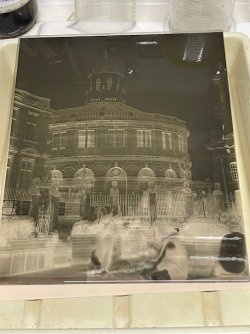
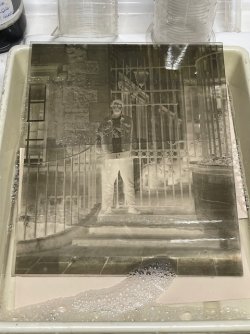
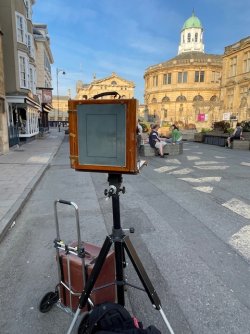
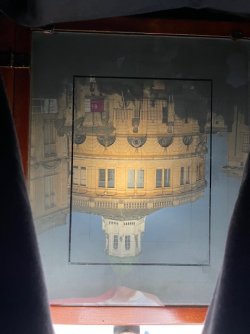
This evening I decided to brave the heat and dragged my 12x10 camera into town to test out my Dallmeyer 15x12 lens for the first time. Having a built in aperture was a huge bonus.

I used Ilford dry plates a friend kindly gifted me. They were found stored in the back of a church.

Rated at ISO 3 and developed in ID-11 1+3 by inspection (23C). Dev time was around 4 mins which was the time I’d previously used at 1+1 dilution at 20C. The darkroom is a bit warm at the moment. The plates are still drying.
 

Attachments

  • IMG_7791.jpeg
    IMG_7791.jpeg
    140.5 KB · Views: 21
  • IMG_7792.jpeg
    IMG_7792.jpeg
    87.4 KB · Views: 22
  • IMG_7793.jpeg
    IMG_7793.jpeg
    112.5 KB · Views: 23
  • IMG_7794.jpeg
    IMG_7794.jpeg
    126 KB · Views: 23
This evening I decided to brave the heat and dragged my 12x10 camera into town to test out my Dallmeyer 15x12 lens for the first time. Having a built in aperture was a huge bonus.

I used Ilford dry plates a friend kindly gifted me. They were found stored in the back of a church.

Rated at ISO 3 and developed in ID-11 1+3 by inspection (23C). Dev time was around 4 mins which was the time I’d previously used at 1+1 dilution at 20C. The darkroom is a bit warm at the moment. The plates are still drying.
Great work! I'll look forward to seeing some prints (and I think there may be other places around town to take that camera )
 
  • Like
Reactions: Nas
Amazing work Nas. Newbie question. The plates look like a negative. John did a portrait of me and showed me the process. When he developed it was a positive. Is this a different process?
 
Amazing work Nas. Newbie question. The plates look like a negative. John did a portrait of me and showed me the process. When he developed it was a positive. Is this a different process?
My dry plates are designed to be negatives to print from. Sounds like John's portrait of you was an ambrotype which you expose and develop differently. It's still a negative on glass until you put it on a black background at which point it looks positive. The density is different and not designed for printing.
 
My dry plates are designed to be negatives to print from. Sounds like John's portrait of you was an ambrotype which you expose and develop differently. It's still a negative on glass until you put it on a black background at which point it looks positive. The density is different and not designed for printing.
Oh thanks for explaining. From what your shared, yes it was Ambrotype. That is the wetplate I’m interested in.

Can I ask what fstop you use and shutter speed. I presume you used a sinar copal shutter?
 
Oh thanks for explaining. From what your shared, yes it was Ambrotype. That is the wetplate I’m interested in.

Can I ask what fstop you use and shutter speed. I presume you used a sinar copal shutter?
I used a lens cap for the shutter. 2 secs f16
 
Back
Top