Sorry I'm hoping the OP will share....I have a question about your darkroom filters;
1. Are you using a colour head or condenser head?
2. Which make and model?
3. Are you using above or below lens filters?
4. Were the filters bought new or 2ndhand and how old are they?

Install the app
How to install the app on iOS
Follow along with the video below to see how to install our site as a web app on your home screen.

Note: This feature currently requires accessing the site using the built-in Safari browser.
-
Thank You For Visiting... Please Click Here and sign up to contribute and reply to posts and download the resources.
You are using an out of date browser. It may not display this or other websites correctly.
You should upgrade or use an alternative browser.
You should upgrade or use an alternative browser.
How do you increase contrast when photographing trees, trunks, logs etc
- Thread starter Camerashy
- Start date
- Joined
- Aug 29, 2020
- Messages
- 1,371
So after some trawling on the net I found this,
- YouTube
Enjoy the videos and music that you love, upload original content and share it all with friends, family and the world on YouTube.m.youtube.com
Conclusion.
Extending development increases overall negative contrast and density.
If all other things are held constant, yes.
But if you extend development AND increase developer dilution AND reduce agitation frequency, you do not get more negative contrast and density. Properly done, you get good negative dynamic range with the midtones well separated. But as noted upthread, this is a tricky technique to master and more often used by ULF shooters, though many of us have gotten quite good results with it in 5x4 and smaller formats. I routinely use it for 35mm and 120 when I want midtone separation.
Underdevelopment gives a thin negative that can be used with higher contrast filters in the enlarger to get better tonal separation between shadow and mid tones.
Not necessarily.
Overexposing and underdeveloping is time-honored Zone System technique. What underdevelopment will do is lower the contrast index of the negative which may- or may not work as you suggest, it's a matter of degree.
Long exposures can increase contrast slightly but not enough to worry about if printing on VC paper
Long exposures will increase shadow detail but may also "blow out" highlights.
In general, exposure mostly affects shadows, and development time mostly affects highlights.
High Alkaline developers produce more contrast and larger grain.
Usually, yes.
Yel/green, green, orange or red filters can be used to increase the difference in tones between colours in the scene.
Have I missed understood or missed anything?
You're off to a good start!
- Joined
- Aug 29, 2020
- Messages
- 1,371
These days I've use a De Vere 5108 with a Dichroic colour head for LF, and a Durst M605 again with a colour head for MF and the odd 35mm neg.
Prior to getting the 5108 I used a Johnson V45, with a De Vere Cold cathode head, and below the lens filters, after Record Rapid was discontinued. I didn't find any difference printing with either filters or a colour head.
Ilford's Multigrade below the lens filters last well, I used a set for quite a few years. The filter drawer filters don't last as long as they are stored in card, which will have a moisture content.
Ian
I should like to put in a word for the Heiland VC LED head which I believe is made in models for most popular enlargers
I know they are ghastly expensive, but my Zone VI VC head died last year. I tried going back to a condenser head with filters and it was so painful, I raided the piggy bank and bought the Heiland. (And the cost was painful.
 ***
***I've now have the better part of 6+ months with this head and it's been just life changing. The light output is very bright, easy to dim, completely stable, and manages contrast pretty much perfectly. I just got the basic controller and it's been everything I needed and more.
No more cold light drift, not more long exposures for high density burning (just increase head light output), built in focusing white light, built in red safelight for easel composition ... it's just a terrific tool.
*** Cost is relative. This head cost a fraction of what I have spent on cameras, lenses, and travel. Moreover, I am at the part of my orbit where I value time above money. Anything that helps me make better use of the remaining time the Good Lord gave me is of great value. YMMV.

- Joined
- Apr 29, 2019
- Messages
- 168
Omega D2 condenser head , Ilford contrast filters below the lens. I may need to assess my filters to see if they have not faded or changed colour.Sorry I'm hoping the OP will share....

- Joined
- Dec 19, 2017
- Messages
- 3,532
You need to check which set of filters you are using. I have variousearly Multigrade filter sets, then 1978 the first Ilfospeed Multigrade, these are marked 1 to 7 and were not adjusted for the same exposures.
The 1982 filters introduced for Multigrade II are still current, and fine for III, IV, & V. These are balanced so the exposures for 1 - 3½ is the same, filters 4- 5 need double the exposure.
Ian
The 1982 filters introduced for Multigrade II are still current, and fine for III, IV, & V. These are balanced so the exposures for 1 - 3½ is the same, filters 4- 5 need double the exposure.
Ian
This is exactly my concern. Sometimes you only notice the difference when you place new and old filters side by side and the difference can have considerable impact on the print.Omega D2 condenser head , Ilford contrast filters below the lens. I may need to assess my filters to see if they have not faded or changed colour.
Equally, a new enlarger bulb. Not only the light intensity but also the light colour changes significantly and degrades exponentially with use and age. So just because it turns on doesn't mean your getting the necessary quality of illumination.
And it goes without saying, using decent multi-coated enlarger lenses.
It's easy to take all these seemingly little things for granted but it can turn really frustrating darkroom sessions into very satisfying and productive ones, just with a little bit of investment.
- Joined
- Dec 19, 2017
- Messages
- 3,532
This is exactly my concern. Sometimes you only notice the difference when you place new and old filters side by side and the difference can have considerable impact on the print.
Equally, a new enlarger bulb. Not only the light intensity but also the light colour changes significantly and degrades exponentially with use and age. So just because it turns on doesn't mean your getting the necessary quality of illumination.
And it goes without saying, using decent multi-coated enlarger lenses.
It's easy to take all these seemingly little things for granted but it can turn really frustrating darkroom sessions into very satisfying and productive ones, just with a little bit of investment.
We think of Multi-Coated lenses as Pentax Super Multi Coating, and similar from other camera & lens manufacturers. Multi[-layer coatings, initially 2, were Patented by CZJ around 1940. Then in the early 1960s multi-layer coatings were greatly improved to give better colour balance/correction.
I don't remember any enlarger lenses being sold as Multi Coated, Schneider state their Componon S lenses are Multi-Layer coated. Almost all enlarger lenses from the late 1950s onward have been coated. Coatings improved in the 1970s but in practice I've found no difference in print quality between Compnon and later S versions, and Rodagons or El Nikkor.
Ian
The Heiland head and the Intrepid version seem quite similar in that both use LED sources. They should both offer a very stable output. I haven’t handled either in person, so I can offer no further information.
As far as plus/minus development goes, would it be fairer to say that more development increases density, and therefore contrast and less development reduces it?
Both increased concentration and increased time have similar effects - a darker negative. It’s juggling the side-effects of either system and combining them that fine-tunes the result.
As far as plus/minus development goes, would it be fairer to say that more development increases density, and therefore contrast and less development reduces it?
Both increased concentration and increased time have similar effects - a darker negative. It’s juggling the side-effects of either system and combining them that fine-tunes the result.
- Joined
- Dec 19, 2017
- Messages
- 3,532
As far as plus/minus development goes, would it be fairer to say that more development increases density, and therefore contrast and less development reduces it?
Both increased concentration and increased time have similar effects - a darker negative. It’s juggling the side-effects of either system and combining them that fine-tunes the result.
In simple terms yes, but in reality the increase is far greater at the highlight part of the curve and very slight in the shadows, thus stretching the tonal range in low contrast situations.
This is from an old Ilford publication, "Perfect Negatives, Perfect Prints", I rearranged slightly. By High Contrast they are talking about development for low contrast subjects.
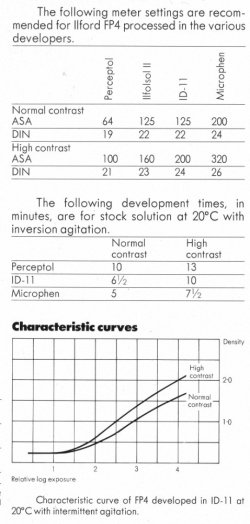
With more dilute ID-11 the % increase is much higher.
Ian

- Joined
- Dec 19, 2017
- Messages
- 3,532
The time % increase for ID-11 above is over 50%. Isn't 20% meant to the standard for increasing contrast?
Ilford are not referring to Zone System nomenclature which uses the N + or - to indicate the increase or decrease. I don't have an old FP4 datasheet, but the increase for Pan F & HP5 in ID-11 is less. By Normal Ilford are developing to a contrast index of Ḡ 0.55, and High contrast of Ḡ 0.70, the first for Condenser enlargers, the second for Diffusers.
In practice these days most Condenser enlargers are semi-Diffuser anyway. Ilford's current FP4+ datasheet suggest 8½mins in ID-11 for all enlargers. But this does raise the importance of calibrating your Exposure Index, and Development time to suit the enlarger used, for Normal - typical use.
When I switched from a Dusrt M601 with condensers to a one with a CLS66 colour head I found I needed a slight increase in development times slightly but it was only 15-20%, I was by then only using Record Rapid grades 2 & 3.
With the Zone System the % change between N & N + or - 1 will vary depending on the developer used, with type, dilution, and also the developing agents used. Some people use + or - 20%, others 25%.
Ian
- Joined
- Aug 29, 2020
- Messages
- 1,371
The time % increase for ID-11 above is over 50%. Isn't 20% meant to the standard for increasing contrast?
It's a matter of how much you want to increase contrast. Zone System dogma calls for testing to determine effective Exposure Index and development times for 1, 2, and 3 (and possibly 4) stop increases and decreases in Contrast Index. This is supposed to be repeated for each film/developer combination under consideration.
I stopped that kind of testing rigor when I realized that I was achieving pretty close to "normal" CI negatives with pretty much all developer/film combinations if I used an EI that was 1/2 box speed and reduced development 20% from recommended by manufacturer. The exception is films in PMK Pyro where I use and EI that is 1/3 stop slower than box speed. I started using this heuristic when I realized that - even with extensive densitometric testing - I was still "tuning" the final process by eye.
Then, for each stop of decreased or increased contrast I wanted, I further reduce or increase development respectively 20% for each stop of correction.
This isn't perfect densiometrically validated data, it's a rule-of-thumb that gets me close. In truth, I rarely have to dial in more than a stop either way. For staining developers like PMK and Pyrocat, I have rarely had to use reduced development to hold highlights, and when I do, It's never more than a 1 stop correction. The big N+- corrections one reads about in the Zone System books like Adams' were likely much better suited to the films of that era than today. For example, I have literlally never needed to do N-4 development even shooting into a 14 stop Subject Brightness Range. Not only do modern films have the ability to capture a huge dynamic range, the use of staining developers like PMK and Pyrocat really does a nice job of managing highlights.
- Joined
- Apr 29, 2019
- Messages
- 168
You did a lot of work, thank you for sharing. It is possible to hold a film reel anywhere on the centre tube of a Paterson tank using a 20mm internal diameter 'O' ring seal on the 25mm outside diameter tube below the reel.This ratio was suggested by Sandy King (the father of Pyrocat) when exploring extended development schemes.
The more important thing is the higher dilution is needed when you're going to leave film in developer for a really long time. These days, I am more likely to use 1.5:1 to 250, 300, or even 500.
It's a tricky process to get right and I've made my notes available to anyone interested. This explains the risks, benefits, pitfalls, and noisy flailing on the internet that surrounds the whole subject:

tundra/Stand-Development
gitbucket.tundraware.com

- Joined
- Aug 14, 2016
- Messages
- 232
Also a factor, probably more so than the film, is that when Adams came up with the Zone System it was based on everyone just using with graded papers (predating multigrade or split-grade printing). So you might have not only been stuck to integer grades, but also you might only be buying the middle grades (if indeed the manufacturer of your paper was making all grades).The big N+- corrections one reads about in the Zone System books like Adams' were likely much better suited to the films of that era than today. For example, I have literlally never needed to do N-4 development even shooting into a 14 stop Subject Brightness Range. Not only do modern films have the ability to capture a huge dynamic range, the use of staining developers like PMK and Pyrocat really does a nice job of managing highlights.
- Joined
- Dec 19, 2017
- Messages
- 3,532
Also a factor, probably more so than the film, is that when Adams came up with the Zone System it was based on everyone just using with graded papers (predating multigrade or split-grade printing). So you might have not only been stuck to integer grades, but also you might only be buying the middle grades (if indeed the manufacturer of your paper was making all grades).
From experience of using an awful lot of Graded paper, I very rarely used anything other than Grades 2 & 3, I did have 1 & 4, usually for printing other peoples negatives.
Graded papers are/were fluid, there are so many techniques to increase or decrease contrast, two bath, or water bath, development, flashing, etc and you had total control between grades. oh and it's easy.
Maybe put that in context. Back around 1986/7 I wanted to go on a Paul Hill Workshop as The Photographers Place in Derbyshire. Workshops were fully booked for more than a year. Paul said I'm doing a workshop at Peter Goldfields new place at Duckspool. So I signed up. it was cancelled because of lack of participants.
Peter asked if I'd go on a workshop with him and Peter Cattrell, a big discount price, so I said OK. It was w a very interesting 4 or 5 days. At the time Peter Cattrell was printing for Fay Godwin, and her book and exhibition "Land, Participants would shoot on the field trips & I volunteered to help Peter Cattrell load & process the films. Peter & I had some interesting discussions.
As we left on the final evening Peter Cattrell said something like I'm sorry we couldn't hep you, and I just turned and said I've probably learnt far more on this workshop than you think.
Ian