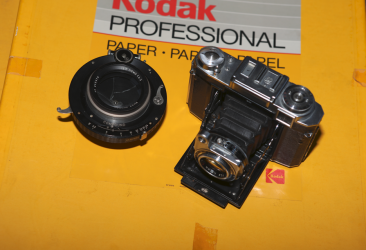
BTW Ian that looks like a particularly nice example of the Ross Homocentric. Wonder how many of these made their way to the U.S. I expect with 8 air-glass surfaces that it did benefit from coating.
David
It is indeed 4 air spaced elements, all coated, I just unscrewed the front and rear elements. The rear pair has the same serial o as the front.
I have uncoated Dialyte lenses and the drop in contrast is considerable, compared to other designs, and particularly to coated Dialytes, like the 203mm f7.7 Ektar.
Pre WW1 lens manufacturers predominantly sold mostly in their home markets, Zeiss & Goerz lenses were made under licence. Ross made Goerz & Zeiss designs, Dagors. Tessars, ect, and Zeiss made wide angle lenses based on a Ross Patent.
In the US B&L made Zeiss lenses. Zeiss set up a factory in London making binoculars and lenses around 1912/13, CP Goerz already had set up an optical work in London in 1899 also making cameras and binoculars, and his sons were making lenses in the US..
5 companies were making Zeiss lenses under licence. Of course the UK was also importing cameras and lenses from Germany, Kodak cameras and B&L shutters from the US. That changed with the outbreak of WW1, all the optical glass came from the Zeiss Abbe works.
The British government tasked Pilkington's with production of specialist optical glasses, the Zeiss London factory was given to Ross, and the Goerz factory closed.
Post WW1 Kodak Ltd made almost all their cameras in the UK, and export to the British Empire, and they only used British lenses. Eastman Kodak distributed T.T & H Cooke lenses in the US, and Dallmeyer Portrait lenses, Kodak Ltd distributed Ross & Cooke lenses in Australia & New Zealand. Ross had an agent in New York (1920 BJPA).
In general Ross was premium lens manufacturer, quality rather than quantity, and they also made binoculars, telescopes, microscopes, and had Government contracts. In terms of camera lenses the highest Serial Numbers seen are in the 270,000's, in 1961, and the company founded was in 1830. That may not include the Ross-Zeiss, or Ross-Goerz, lenses, they are thought to have had their own serial numbers, the military lenses also have their own numbers.
After WWII Ross merged to became Ross Ensign and continued supplying the lenses shutters for the Ensign range of roll film cameras, as well as the lenses for the MPP Microcord. By the late 1950s Ross Ensign couldn't compete, people were switching to German and particularly Japanese 35mm cameras, the market for v120 folding cameras collapsed, camera & camera lens production ceased in 1961. Ross continued with military contracts, also making binoculars and enlarger lenses until being taken over in 1975.
So a long answer to how many ended up in the US. Maybe a few pre-WWII. I doubt Ross made many coated 12" f6.3 Homo(centric) lenses post WWII, and even fewer in a shutter. I can't find a reference or advert for the lens & shutter. It's worth substantially more than I paid for it.
Ian