THE BRITISH CAMERA 1840-1960 THE JIM BARRON COLLECTION

There appear to be some prototypes in that listing. The post WWII VN, Van Neck, Press cameras for instance, and an SLR.

In the last big collection I saw for sale many items sold for less than the estimate, that was maybe just before Covid. However, the cameras were more common, nothing unusual and no prototypes.

After WWI Peeling & Van Neck took over the C.P. Goerz, London factory which had been set up in 1899 to make cameras, and lenses. They continued by making The All British Anschutz camera, later called the Van Neck Press camera after Goerz merged into Zeiss Ikon.

Under the "Trading with the Enemy Act" 1914 German products could not be sold in Britain & the Empire. A 1916 amendment allow the Government to sell off seized stock. Peeling had worked for Goerz before the war, but the KUK limited company was wound up in 1917,
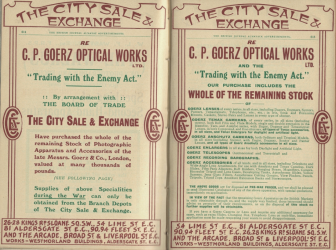
1771168923154.png

Peeling & Van Neck were Goerz agents after WWI from 1923 to 27, then Voigtlander, as well as Deckel & Gautier shutters. But the partnership split up during WWII, as imports from Germany ceased.

After the war Peeling & Komlosy were the Zeis & Zeiss Ikon importer. There were all the Van Neck prototypes in that collection - 5/

And then 2 Nilrod cameras, these were made by Williamson, who made aerial cameras, they were sold by Dawes Instruments for a very short time. But BJP Almanacs show other very short livid cameras.

So who was Jim Barron, 1927-2002 ? That becomes interesting as he was a photographer and cinematographer who worked for the civil service, often in the field of overseas aid. Then you find 4 of his images held by the National Portrait Gallery, photographing musicians, including a very young Pete Townsend in the early 1960s.

Then you ask how did he acquire Prototypes, but post WWII UK manufacturers were after lucrative Government contracts & investment, so who knows, someone in the Civil Service had to evaluate cameras . . . . . . . . . .

Ian
 
Sadly Jim Barron is no longer able to shed light on these questions. Such a shame. Quite the collection he put together. I have an auction catalogue for Terence Donovan's camera collection somewhere.
 
Sadly Jim Barron is no longer able to shed light on these questions. Such a shame. Quite the collection he put together. I have an auction catalogue for Terence Donovan's camera collection somewhere.

I made a screen for Terence Donavan's old 15"x12" camera a few years ago. I knew the person who had bought it at the auction, but there was an issue, the GG frame holder had been modified to take a very thick maybe 1/4" screen, which I still have. I had made a 2mm screen which was then sold with the camera, but it turned out I also knew the buyer, who was not at all happy, as the register was way out.

The same seller listed a pre-WWII Half Plate camera which took Book form holders, with a modern International 7x5 (or half plate) film or plate holder as perfect fit in a photo. I began noticed other odd listings. The seller has not been active for some years now.

Ian
 
I made a screen for Terence Donavan's old 15"x12" camera a few years ago. I knew the person who had bought it at the auction, but there was an issue, the GG frame holder had been modified to take a very thick maybe 1/4" screen, which I still have. I had made a 2mm screen which was then sold with the camera, but it turned out I also knew the buyer, who was not at all happy, as the register was way out.

The same seller listed a pre-WWII Half Plate camera which took Book form holders, with a modern International 7x5 (or half plate) film or plate holder as perfect fit in a photo. I began noticed other odd listings. The seller has not been active for some years now.

Ian
I wonder if Donovan ever used the 15"x12" camera or was it just part of his collection? I can't find any pictures of him online using old plate cameras. In my search I found a website selling the auction catalogue for $96. That's a bit keen, it isn't even in colour. the auction was in 1997 but unfortunately the Christie's website only lists past auctions from 1998.
 
Somewhere (in a book) I've seen a photo of Donovan stood near a large field camera on a tripod or stand, I think he had it as a prop rather than to use. He did use a Linhof Technika, and earlier an Anniversary Speed Graphic, as well as smaller formats.

I don't know when large film sizes were discontinued. Half plate and Whole plate were still available on the shelf, when I opened a trade account with my Ilford supplier in 1977, but had been discontinued.

The 1940 Kodak Professional Catalogue shows all Kodak B&W sheet films available in sizes up to 10"x8", most in 12"x10" except Tri-X and Super Panchro Press, and only 2 Commercial films in 15"x12". This was still the case in 1960, but by 1966 there were fewer 12x10 films, and the Commercial films are listed as for duplicating, copying, with the line "can be used for general photography were speed and colour sensitivity are unimportant".

So Donovan could have used the 15"x12" camera at some stage early in his career, but when I saw the camera around 2013 it was compromised.

Ian
 
How would you evenly develop a sheet of 15"x12" film? Big trays? Seems like a recipe for scratches. I've never seen deep tanks big enough for that size. When I was hand processing 10"x8" E6 sheets in deep tanks we had stainless steel film hangers made by Hewes which dropped into slotted racks. For even development we had nitrogen bubbles pumped in every 10 secs. If I think of that setup scaled up to 15"x12", things suddenly start to get unwieldily.

I think 10"x8" would logically have been as large as Donovan would go. If it was good enough for plenty of photographers before him I can't see why he'd need to go even larger. You'd be reducing the size to get it onto a magazine cover.
 
Well the Kodak 15"x12" Commercial films were not Panchromatic, two essentially similar emulsions but on different bases, and there was also an Ortho version. All available in sizes up to 24"x20".

So non-Panchromatic and Ortho, and also slow emulsions, makes tray development by inspection easy.

I think Ilford & Eastman Kodak called these Commercial films "Process films".

You'd be reducing the size to get it onto a magazine cover.

I knew the head photographer at Kays, the Worcester based mail order catalogue company. Like Littlewood & John Moore, all the catalogues were printed 10x8. That was the largest colour transparency film available.

Every image was shot to exactly fit the page layout. They had about a dozen studios, in the same large building, often with more than one table-top set up, as well as full boom sets, around 20 full-time photographers, and then assistants. They also had an in house E4, later E6 processing facility.

Ian
 
Well the Kodak 15"x12" Commercial films were not Panchromatic, two essentially similar emulsions but on different bases, and there was also an Ortho version. All available in sizes up to 24"x20".

So non-Panchromatic and Ortho, and also slow emulsions, makes tray development by inspection easy.

I think Ilford & Eastman Kodak called these Commercial films "Process films".


I knew the head photographer at Kays, the Worcester based mail order catalogue company. Like Littlewood & John Moore, all the catalogues were printed 10x8. That was the largest colour transparency film available.

Every image was shot to exactly fit the page layout. They had about a dozen studios, in the same large building, often with more than one table-top set up, as well as full boom sets, around 20 full-time photographers, and then assistants. They also had an in house E4, later E6 processing facility.

Ian
I remember those mail order catalogues. For the work Donovan was doing I can't see any benefit to using 15"x12" when 10"x8" would've got the job done perfectly well and offer a much wider range of film emulsion options. That's my tuppence worth :D
 
Back
Top