Filters/Advice For 10x8 Contact Printing?

M

Moose

Guest
Hello, I am looking at making some contact prints in 10x8 as I do not have an enlarger. How is contrast usually controlled in a 10x8 contact? Is it all done in the negative/development? I know that once there were many graded papers to choose from but there dont seem to be very many remaining.

Also, is fiber paper a good choice for contact printing? Iv made enlargemnts on it but not sure how much the curving nature of the paper after drying would work with such a small print.

I am possibly looking at aquiring an enlarger at some point which would allow me to just use the filtered light from it but a cheaper alternative for now would be more ideal. I could build something to box in the printing bulb and fit a filter underneath it, which is perhaps the best option.

Thanks !
 
My advice would be to find a cheap colour enlarger and use that as the light source, that way you van use the colour head's filtration and any MG paper. The enlarger format isn't important.

Fibre based papers are fine for contact printing. Your other option is fixed grade papers, but there aren't many left with a good range of grades.

Ian
 
How is contrast usually controlled in a 10x8 contact?


Hello, Moose,

a negative contrast fitting well to your paper is of course a good starting point, but there are a dozen of different possibilities, too.

For further control and while talking about VC paper you may choose splitgrade printing or classic printing via Ilford's contrast filters, or as said by Ian with enlarging colour heads.

Dodging and burning is useable, too.

If you are a friend of dirty tricks then you could figure out a twobath development - hard developer+smooth developer.
Or smooth developer only.
This could give nearly one grade difference to your print.

Printing darker followed by partial bleaching is fine if wanted or required.
Pulling the print early out of the soup is another technique.
This are no fine art techniques but allowed if they enhance your print, your difficult contrast situation.

The other thing is masking and copying, or masking and copying the copy and so on.

You also could liberate your artistic energy and scratch, write, paint or otherwise destroy the negative in a somehow creative style which will change the tonal range depending on technique and colors used.

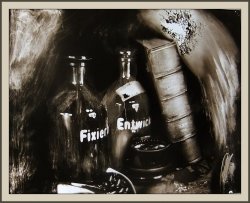
This is a 12x16" contact print of a paper negative in which the bottles came out way too black depending on the orthochromatic's nature of photo paper.
Touched by the cobwebby appearance of the bottles' surfaces given by a ballpen I succumbed to an enthusiasm; I continued with weird wiping and with notorical abrasing of some emulsion.
This way I discovered a widely range of new possibilities to my photography and of course the fun in contact printing:) .

Eder Ton.jpg
 
Last edited:
I've used a small (7W) round incandescent bulb in a reflector above the contact frame with multigrade paper, then placed these Ilford filters atop the frame's glass:


Expensive for more than a few grades, but functional, especially if one doesn't have space for, or want to go through the effort of temporarily setting up, an enlarger as light source.
 
It shouldn’t be too difficult to take a smallish lamp (preferably with LED because of the heat) and cobble together a holder for the smaller enlarger size filters. Some printers arrange something (a couple of hooks) to hang the lamp at different heights to give a choice of convenient enlarging times.
IKEA might be a good start.
 
Back
Top