The Fractal Attractor

thronobulax

Very Active Poster
Registered User
Joined
Aug 29, 2020
Messages
1,394
The hardest things to see are the things in your own backyard. That said, I find myself being drawn back so several places in my immediate environs to try and make new pictures. There's that marsh nearby that looks so different across the varying light of the seasons. There's the old cement factory that beckons with promise. There's odd little railroad repair yard that has an endless of array of visually appealing detritus.

The hard part is going back to these places and finding new things. I do it because it's been a rewarded behaviour. I do it because it forces me to see in new ways.

What are your fractal attractors?
 
Curiously enough, I’ve just been watching a programme about Monet, who painted his own garden in various different lights.
(I believe the US word “yard” includes gardens. In English it means an enclosed paved area.)
 
Curiously enough, I’ve just been watching a programme about Monet, who painted his own garden in various different lights.
(I believe the US word “yard” includes gardens. In English it means an enclosed paved area.)

Yes, that's a pitch perfect example. I'm also reminded of Weston's famous 'Pepper No. 30'. Not only did it take 4-6 hours of exposure to get that image, it suggests that he tried at least 29 times prior with more-or-less the same subject.

I used to think that revisiting past haunts wasn't productive if I used the same tripod holes. No, no, no, says me, I must find new views and perspective of old material to really mature as an artist. I've since changed my mind. Working hard to learn to really see things - especially the common things around me to which I have become blind - benefits from trying to reimagine the exact same scene. That's because it really isn't the exact same scene. The light it different. The shadows move differently. My sense of composition begins to reimagine the composition. Yes, some of this results in repetitive dreck - perhaps more often than I'll admit - but it at least serves to hone craft for that moment when I do see the next amazing thing.

For more on Weston's pepper, see: https://petapixel.com/2017/08/15/famous-pepper-photo-edward-weston-4hr-exposure-f240/

The video linked there is well worth your time.


P.S. I love the fact that you (very properly) distinguish between the "US word" and English. That had me chuckling loudly. As someone who learned English in three different nations, none of them the UK, the cognitive dissonance of word usage across the world can be headache inducing. I will also stipulate that gardens in the UK are among the loveliest places I've ever seen.
 
Last edited:
Yes, it looks like the same word, but it means something different. Not uncommon. Purely out of interest, what would be an enclosed hard area in the US?
I was applying the convention that the first instance of something needs no qualification. Hence, we can say “United States” without ambiguity, for where you live, but another group of states that joined together would be stated in full - “United States of Europe” for instance.

From memory, one of Mr Weston’s problems with his peppers wasn’t photographic at all. Heavy lorries passed nearby and the vibration could cause his subjects to move. There may well have several, even better, mute inglorious pepper images, spoiled by double imaging. Again from memory, it was placing Number 30 in a galvanised funnel that was the final piece of the jigsaw.

I'm not sure there is a direct Americanism for "an enclosed hard area". The word "garden" here is defined as a place where plants of any kind (vegetables or flowers) are growing, whether by accident or curation. So, an enclosed hard area with flowers or vegetables growing within it would be referred to as a "garden" but what makes it so are the plants not the enclosure.

Yes, Weston did eventually put his pepper in a funnel for that picture. The bit about the lorries was new to me though.
 
Last edited:
The place where locomotives and other rolling stock are rearranged and stored is called a marshalling yard, so it’s not entirely domestic.
As far as I know there’s no connection at all with the Imperial measurement of three feet.That was a King’s arm, but I forget which one.
I also forget where I heard about traffic vibration. Might be buried in the Daybooks but I don’t think so… one of his sons, perhaps?
 
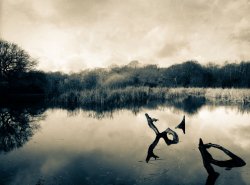
I have a bit of Epping Forest called Hollow Ponds that is only 15 minutes walk from me. It's been my 'test ground' for new equipment, I shot my first 5x4 image there, and I've captured it in every light and at every time of year with all formats I own. I may do a photobook about the place one day as it has a fascinating history: gravel mining pits were turned into a complex of boating lakes and an outdoor swimming 'lido' by unemployed labour around 1905, the whole area becoming a recreation area for the poor and rich of East London alike. The swimming pool was closed for WWII and never properly re opened ... being finally demolished and filled in. The boating lakes are still there however and busy as ever :) During the height pandemic they were the only places for many to exercise.
ponds-Edit-2-Edit-Edit small.jpg
 
Weston certainly had trouble with the Nautilus shell.

"The next day: "The shells again moved! It must be the heavy trucks that pass jar the building ever so slightly. Anyway, I have quit trying: I can afford no more film." " Daybooks 2 p28

The reference came easily to mind as I tried to make an image of the same subject last year.

I have been thinking a lot lately of the work of John Blakemore.

His beautiful tulips and the simplicity of one camera and one lens.

I have a few of the local trees in mind for a small series...
 
Not quite one camera. I have one of his small domestic interiors, taken with a Leica.
I do share your enthusiasm. If you can find a workshop…

The word patio seems to be popular to designate a hard area with plants, at least in the UK.
 
Last edited:
The idea that Blakemore used only one 5x4 camera with a 180mm lens and a leica with a 35mm lens may be a bit of a myth. He invited me to his house once for a meal. The boiling potatoes made interesting steam patterns on the kitchen window, and he took several photos of it- with an Olympus XA.....

Alan
 
I took a test shot, literally in my back yard, just outside the back door. A came across it a while later as I was looking though some images and thought 'that look's good, where's that?' then realised it was my own yard. I liked the notion of that realisation - even though, on reflection, I sound a little bonkers!
 
Back
Top