Presentation Ideas

Ian-Barber

Admin
Registered User
Joined
Aug 6, 2016
Messages
1,723
I haven't made any photographs for several months now mainly through lack of inspiration so I have been mulling over the idea of making a small project.

The contact print project
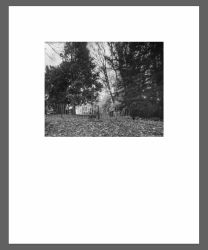
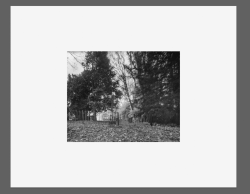
I am thinking of darkroom printing a series of images as 5x4 contact prints on 10x8 paper of the same genre of subject matter for consistency. There maybe some square ones as well.

Presentation:
The final presentation will be mounted prints which will reside in a 10x8 black felt lined box

Conundrum:
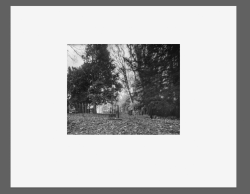
I have 2 options for the orientation, vertical or horizontal and I am still undecided which way to go although I do like the vertical orientation one.

Just curious to see what other folks think. I have just made a rough mockup in Photoshop to show what I am thinking
1781

1782
 
We've had this discussion before:

1784

This has been my approach to prints made with my TLRs (square) and those made with my 5x4 or 10x8 cameras. The cord needed tightening on the right hand side image to align them better.

You'll see a significant offset from the bottom with the square print, not as much as in your firts example, but there's also an offset with the second somewhere around a 1/4 to 3/8 of an inch.

1785

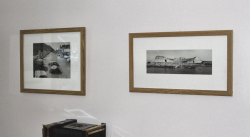
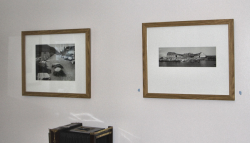
My conundrum is I also shoot 6x17 and after a couple of years chose the framing on the right, Initially I'd used the same sized frames, as below.

1786

My main frames are 20x16 but I also have 30x24, these are the same proportions (ratio of edges) to your idea.

This is your second idea with the image offset slightly from the base.

1787

Ian
 
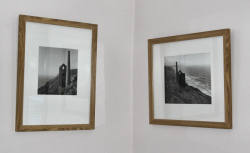
I remember seeing Ian's images framed on the wall and I did like the presentation. I also like the way in which your images are presented Mono, you seem to have gone for a much wider border between the image and mount edge
 
As Ian and one or two others here have seen while I'm consistent in framing my project/exhibition work I also have iamges framed differently. Most of these are the work of other Photographers, John Blakemoe, Fay Godwin, Robert Doisneau etc.

It's always worth experimenting. I do use some square frames but not in my exhibition sets , that may change at some stage.

Ian
 
Printing on square paper would seem like a logical compromise.
 
This is, of course, all a matter of what looks pleasing to your eye, but... Many years ago, I did a project of 5x4 contact prints mounted on 12x9" 4-ply boards very similar to your vertical mock-up above. Therefore, there was quite a bit of "real estate" on the bottom side of the matt. I never framed these prints; rather I stood them up on a chair rail in our living room. IMO, it was a quite nice presentation.

For square prints, I typically mount them just like Ian G shows above with just a bit more spacing on the bottom. For more pano-style prints, I tend to use even spacing all around.
 
I think a lot depends on framing costs. Ian is talking about presentation (to what end he's not said) but wants a standard of 10x8.

These days I can buy frames for much less than 30 years ago by a very significant amount. I'm on my third set of Exhibition frames. While I've not totally retired the first some need a minor revamp, as do a few from the second set (but less so). but we are talking after 25-30 years use.

The frames I use now are almost certainly Chines, they ae well made, cheap, and available in a wide variety of sizes. While I have possibly 60+ I add spares as and when I can. And I do have the option of square frames of the same profile.

BAck in 1994 hwen I had my first majir solo exhibition the framing costs wer £600 just for the 16"x12" frames then there were 6 30£x24" and additional 20x16 on top. Framing's an expensive part of the process, and taht doesn't include matting.

Ian
 
Wow...you've bought a LOT of frames! For most of my photographic life, I've used Nielsen aluminum moldings. Early on, I bought them pre-cut, but later bought long lengths allowing me to custom cut to any desired size. Lately, I've been doing quite a bit of pt/pd printing (and have purchased pt/pd works of other photographers) and I tend to prefer a wooden frame here. For my own personal work, I've stuck with standard sizes which means I can buy pre-made frames. I wouldn't say they're cheap (11x14" runs $20US), but I don't buy anywhere near your quantity level.
 
Well I built up my first set of frames slowly over about 4 or 5 years, so that wasn't to bad financially, and they were used for a number of exhibitions. I was selling more prints back then and that helped significantly towards the costs of printing and framing.

The larger set were paid for indirectly as I had a large gallery exhibition and had partial funding from my regional Arts Council towards production costs (travel, film, printing, processing and tume), also the Gallery paid a fee to show the work. So while technically Arts funding can't be used for framing I was recouping other costs. The argument against them paying for framing is valid, if they specifically pay for frames they should be available for others to use afterwards. Some galleries have sets of frames themselves usually the aluminium type (or used to).

My first two sets of frames came from Trade suppliers so weren't too expensive. For the second set the framer in 1994 had the Sapele wood profile specially cut which sounds expensive but was quite the opposite because of the quantity. These frames were supplied plain no glass or backs just the brass tags to hold everything in place and I had to stain the wood. The glass and backs came separately at cost. This kept the cost of a set of 20"x16" bespoke frame down to £10 each.

The problem these days is cheap Chinese imports have decimated the smaller picture framers who can't compete on price making frames to order. I have to admit I'm buying these Chinese frames myself and they are well made, a 20"x16" frame is under £5 and some sizes come with a pre-cut matt (which is no use to me). So quite recently I've begun to slowly building up a third set of frames, at this price I can pick up a couple each time I'm in the shop. These are the frames Ian Barber and a few others here have seen.

Ian
 
My intension for this project was not to frame them, we just dont have the wall space here plus the. "boss" is not keen on the subject matter I like to photograph.

I wanted to to simply place the printed images inside a portfolio box which can be lifted out separately hence the reason for trying to get some uniformity with how they look on paper.

The other issue I am faced with is trying to get clean edges around the print, would be nice to have a 4 blade easel but I don't so I am having to improvise and make some L shaped corders out of matt board to stop the remaining of the paper from going black
 
When I made some large prints for my 30"x24" frames I didn't have an easel large enough. I cut out a matt board for the actual image area and then blackened the inner edges and surrounds with an indelible marker, this is more precise than two L shaped bits of card.

Ian
 
We have been diverted into an interesting discussion on frames.
What kind of box were you considering, Ian? Something like the standard portfolio box or something different? I'm thinking that it might be a good idea if the container itself echoed the subject matter in some way.

When I made contact prints on a single sheet, I simply cut a mask, very carefully, in thin black card. (New scalpel blade, decent rule, good light, take time.) If you have difficulty cutting immaculate corners, then cut the aperture a little too long and use extra strips at top and bottom to bring it back to size. The overlapped corners should be perfect.
 
Ian B,

Have you thought about doing a folio? See http://www.brooksjensenarts.com/folios.html. Brook's presentation is digital prints, but I don't see why it wouldn't work for analog silver prints, if you can flatten the prints (assuming FB paper, here.)

As for clean borders, I have a friend who cuts matt board to the print size needed (as Ian G suggests), then tapes the top side directly onto the enlarger easel. Places paper under the matt and uses steel L-brackets (painted black) at each corner to hold everything in place and for a nice clean border. He even has slightly smaller solid pieces of matt board that are placed inside the "frame" to get a thin black border around the image.
 
I think Matt board is going to be the answer here and I like Ian G suggestion of putting black marker pen along the edge which I am guessing is to try and stop light from creeping underneath

That and will eliminate random light bouncing back onto the paper surface. Sorry, I forgot you already have experience with folios.
 
Back
Top