How do you develop your film?

+1 for Combi-plan. I bought my tank to be able to do quarter plate; the film holder is adjustable for that, 9x12 cm, and 4x5, and will take sheet film (in curved slots) or plates (in straight ones). I have a weakness for old cameras, so this ability was very attractive (though I haven't used many of these exciting possibilities yet).

I have come near to breaking the tank on a few occasions though. For roll film I use stainless tanks, and if I could replicate the Combi-plan in steel, I'd be a happy bunny.
 
Hi Keith nice to see you here :)


My understanding is that the replacements are not exactly the formula as the original Agfa Rodinal even though they say it is, I have RO9 and Adox but once opened they soon take on a very dark brown tinge and I am a little hesitant to use either now.


This is something I picked up on the web and quoting it, sounds plausible to me.


"Of course they`re not precisely the same as Agfa Rodinal. Even the one`s that are based on traditional Rodinal formulae are not the same as the stuff that Agfa makes. The Agfa brew contains Hydroquinone and Potassium Bromide which the traditional formula doesn`t have and neither does the stuff that the Photographers Formulary sell. Agfa Rodinal is the companies formula and not published for use in the public domain which means when their stuff runs out of stock, then that`s the end of it. You asked for an alternative to AGFA Rodinal and apart from the brews based on the old traditional Rodinal formula, then there isn`t anything that I am aware of that is close to being near to the commercial Agfa product."

Any views on this and if the above is correct
 
I mostly use Jobo Expert Drums for both 4x5 and 8x10 and, occasionally, use a B&W King stainless tank (4x5) for semi-stand or stand type development.
 
I'd better start by saying that as far as I know, Agfa have not published the formula that was used for last Agfa Rodinal made. Without taking all the variants into a lab and analysing them, I can't comment on how similar any of the variants are to each other, the final packed version, and the published formulae.

The following comments are the best I can offer. First, from the Film Developing Cookbook, 1st edition

Agfa Rodinal no longer corresponds exactly to the traditional formula. It still contains p-aminophenol and potassium hydroxide, but in smaller amounts. Potassium bromide has also been added, which would not be necessasy if p-aminophenol were still the sole developing agent. Some photographers prefer the traditional version; others the commercial version. Dr. Elie Scheeour believes that the differences are not photographically significant.

I'd read the last as implying identical results (or nearly so) but without comment on the keeping properties.

The Darkroom Cookbook, 3rd edition, gives a formula for Rodinal and adds

In time the developer will turn dark brown. However, the unused stock solution will last for several years.

That's as much as I know.

Edit to add: the Film Developing Cookbook does have more information at the point where it gives the traditional formula for Rodinal, particularly with regard to the effects of aging (spoiler - people disagree on whether it gets better or worse).
 
Last edited:
It was the squeezy pouch/gloopy (?) developer combination that I thought might address the spoiling problem. I have always been a little sceptical regarding the missing 'magic' ingredient, or indeed the 'extra' ingredient in formulae, as manufacturers in all fields are well practiced in the dark art obfuscation in the hope it may give them a commercial advantage, sow the seeds of doubt us poor souls in the field and lock us in to their product. ;)
 
With a Jobo and conventional one-shot development I used a pre-rinse (and that causes a lot of debate...). With Thornton's Two Bath, I don't. The pre-rinse seems to compensate for the constant agitation increasing development. Otherwise expect some reduction in development time.

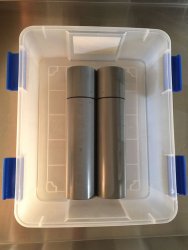
Before I acquired my Jobo I used black ABS plumbing pipe to make single 5x4 sheet daylight tanks. This is widely available in California, but I seem to remember that in the UK there is only grey, which is probably not light-safe. I still use them for odd times when I need intermittent agitation, or do not want to rig the Jobo.
 
That question could fill a book, the other good question is what developer do you use and why. Right now if I'm going to scan I use diafine in tanks and hangers. I just started to play with PMK pyro for pt/pd printing and tray develop. I have a jobo but not sure how the developers I use work with continuous agitation.
 
For 5x4 and 5x7 sheet film I use a Paterson Orbital Processor, with 300mls of developer. I don't have the motor so I agitate continuously, and very gently, by hand.

Alan

Hi Alan. Do you use the non-motorised base to agitate, or sit the tank flat and raise the corners in rotation? I have had limited success with the orbital, and found I needed much more developer to get even coverage. I would be keen to use it if I can find a way of obtaining even results with a low volume of developer.
I also use a MOD54, which must be the second version. I can highly recommend it. I tend to load four, rather than six sheets, although I'm sure six would work fine. I think it's a great piece of design, and I particularly like the way it has been engineered to fit an existing product.
I have also tried tray development. It's ok if you have plenty of bench space, but I prefer some type of daylight equipment for convenience.
Alex.
 
Hello Alex.
I don't have a base. I agitate by raising the corners of the unit by a few millimetres, in a gentle, continuous and random fashion. I have found that agitation has to be continuous, or uneven development occurs with "tidemarks"

Alan
 
Thanks Alan. I will give it a try with my next 4 sheets.
Alex.
 
I just started to play with PMK pyro for pt/pd printing and tray develop. I have a jobo but not sure how the developers I use work with continuous agitation.

Doug,

PMK will not play well with the Jobo. If you'd like a great pyro-type developer that will work well in the Jobo, especially for pt/pd, try Pyrocat-HD or the -MC variety. For pt/pd, use a 2:2:100 dilution. Regardless of dilution, run the processor at its slowest speed; this will minimize aerial oxidation.
 
I have been processing sheet film for some 60+ years. Tray and/or hangars, and when 'working'... a Wing-Lynch. This past 15years (or so) I have been using the 'old style' (grey) BTZS tubes for both 4x5 and 8x10.
My developer of choice for all my film is now Pyrocat HD... 'hand rotated' in a large water-filled Tupperware container that sits on an old water-bed heater to maintain temperature... works like a charm :cool:.

Ken
 
My developer of choice for all my film is now Pyrocat HD... 'hand rotated' in a large water-filled Tupperware container that sits on an old water-bed heater to maintain temperature... works like a charm

Would like to see an image of this setup Ken :)
 
Ian, not Ken but I just used mine this morning. Imagine the plastic container about 1/2 filled with water.
 

Attachments

  • BTZSSetup.jpg
    BTZSSetup.jpg
    88.3 KB · Views: 14
Ian... I'll set up a 'fake scene' (just as it is set on my darkroom benchtop) sometime to-morrow on the dining room table when She Who Must Be Obeyed takes the dog out for his long walk...and put the iPhone to work. I don't feel like I want to load up film holders and 'do the real thing with the Linhof... then wait until my new Epson film scanner arrives (in about a week to ten days) and scan a neg. I 'think' the Q & D digital 'snap shot' should do... or.... How about an Iphone video?

Half fill the Tupperware container about half way with water 'at temperature'... and... always working with and EVEN number of tubes (I usually do 4 tubes at a time for 4x5... but only two sheets at a time for 8x10). The tubes get 'changed over' for the 'opposite' rotation direction... usually about every minute or 90 seconds or so. If.. and it is not often.... I am only developing one sheet I'll still put another tube (without film) containing a similar volume of 'plain water' at temperature to "balance" things out. At the 'end' of the developing time, REMEMBERING to turn all light off.... I unscrew the top... dump the developer in a one litre measuring jug... submerge the open tube into the Tupperware container (rather than use a stop bath) and pour in some fixer.. into the top... invert the tube over the top... then quick (like a bunny) screw the tube 'into the top and after a 15 to 20 second 'shake', replace the tube back into the water bath and rotate in as if 'developing' It take longer to 'describe the how' rather than doing it. Before I 'invested' in the tubes I had made my 'own' from black plastic (plumbing) tubing and 'caps'... to see how well it might work. All went quite well... but I think investing in 'the real thing' was 'easier/better' ... since they 'balanced better' in the water bath.

Ken
 
OK, I didn't go into all the detail like Ken, but my process differs slightly. I have extra caps for all my 8x10 tubes. The night before, exposed film is loaded into each tube. The next morning, I set up the water bath container, stop bath tray, and fix tray. I fill each 'extra cap' with developer, then turn out the lights. Tubes are moved from the no developer cap to the ones with developer. Turn on the lights. Shake two tubes for about 10 secs and complete development using the same method as Ken. About 15 secs before the end of the development time, I pull the tubes from the water bath and stand with caps down. Quickly turn off the room lights, then unscrew from caps and move to stop bath tray. Roll around in stop for 1 min. Move to fixer tray and roll around for 1/2 the fix time. Turn on the room lights, pull film from tubes, and complete fix cycle. Wash, etc.

Like Ken said, its a lot harder to describe than to do. Confession though... I generally use the BTZS tubes when I have only a couple of sheets to process or I'm just too lazy to setup the Jobo. Either way, you'll get pristine negs! :)

Oh, and I, too, used Pyrocat-HD for many years and just recently switched over to Pyrocat-MC.
 
I started with the MOD54 but didn't really like it, wasn't quite getting the results I wanted, probably user error more than anything else. Now I have a small collection of combiplan tanks which I use and combined with the Nova FP 5x4 processing unit (as seen in this article by Paul Gallagher) I get very good and consistent results when used with my developer of choice, Prescysol EF. I don't use it for dip and dunking but for bring the water/chemicals up to temperature before being poured into the combiplan tanks.
 
OK, I didn't go into all the detail like Ken, but my process differs slightly. I have extra caps for all my 8x10 tubes. The night before, exposed film is loaded into each tube. The next morning, I set up the water bath container, stop bath tray, and fix tray. I fill each 'extra cap' with developer, then turn out the lights. Tubes are moved from the no developer cap to the ones with developer. Turn on the lights. Shake two tubes for about 10 secs and complete development using the same method as Ken. About 15 secs before the end of the development time, I pull the tubes from the water bath and stand with caps down. Quickly turn off the room lights, then unscrew from caps and move to stop bath tray. Roll around in stop for 1 min. Move to fixer tray and roll around for 1/2 the fix time. Turn on the room lights, pull film from tubes, and complete fix cycle. Wash, etc.

Like Ken said, its a lot harder to describe than to do. Confession though... I generally use the BTZS tubes when I have only a couple of sheets to process or I'm just too lazy to setup the Jobo. Either way, you'll get pristine negs! :)

Oh, and I, too, used Pyrocat-HD for many years and just recently switched over to Pyrocat-MC.


Oh dear... The perils of getting 'older'... I forgot that I said I would get some 'quickie' iPhone images of the 'how I do it' but I think Alan's 'depiction' is more than enough even though I use a larger 'Tupperware' container that allows me to 'do' four 4x5 or 8x10" tubes at a time. They 'bob' as they are rotated.. and they DO provide for very even development. I remember my early tray-development technique with the ONE glass plate at a time (can you spell 'slow?) or of multiple sheets of film... the occasional scratch when doing 4 (or more) at a time? OR... occasional 'dark' spot where the fingers grabbed the 'slippy' film?

It does make it much easier to have the 'extra caps'. I then fill my 'extra caps with a rapid fix and set them to the 'rear' of the tub (I 'know' where they are.. and are much less likely to be 'knocked over' and/or 'moved' by an accidental bump').

Since I not not feel it necessary to use an acid stop bath with Pyrocat I just set the tubes on the bench-top with the caps 'down'.. unscrew the 'tube' and submerge them down into the water-bath for a short 'wash/stop' and, while still in the dark lift them out, turn the tubes 'open end down' and screw them into the 'stand-by' tops that contain the fixer... lift (up to 4) give them a quick 'shake', drop them back into the 'water-bath' and rotate for the 'fixing' time. The film is then transferred to a tray for washing with my 'old-fashioned' Kodak (syphon-type) washing do-hickey... or placed into film hangers for a 'tank wash' under the tap.

For significant a number of years I used wooden clothes-pins that had a thumbtack 'through' from the 'outside' that penetrated the film (and left a small hole... or at least a 'dimple') until such time as I 'found' the Kinderman 'clips' that were marketed for dentists for drying dental x-ray films. I sometimes now wish that I had had invested in at least twice the number... Over the years, they have proven (to me anyway) to be the BEST.... BUT....much more expensive than 'borrowed/stolen clothespins (YMMV... :cool: ).

Ken
 
Back
Top