
Install the app
How to install the app on iOS
Follow along with the video below to see how to install our site as a web app on your home screen.

Note: This feature currently requires accessing the site using the built-in Safari browser.
-
Thank You For Visiting... Please Click Here and sign up to contribute and reply to posts and download the resources.
You are using an out of date browser. It may not display this or other websites correctly.
You should upgrade or use an alternative browser.
You should upgrade or use an alternative browser.
Digital 1/4 plate image
- Thread starter Paul Kay
- Start date

- Joined
- Sep 25, 2017
- Messages
- 378
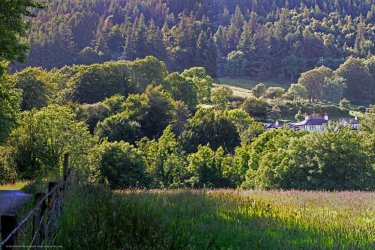
Can I ask what are the pixel dimensions of the stitched image?Shot using a step & repeat process - 9 image stitch. 1865 Grubb lens on Sony A7II.
View attachment 4807
- Joined
- Sep 25, 2017
- Messages
- 378
About 6000 x 4000 pixels BUT I didn't open the images at 24MPixels so ....
Hmmm. I'm not sure that qualifies as LF. Scanning a 5" x 4" sheet of film yields 12,000 x 9,600 pixels, which is 115Mpx.
If I take a single shot on my Nikon D850, that gives me 8,256 x 5,504 pixels or 46Mpx and I can pass one of those files through Topaz Photo AI to give me 182Mpx and the Fujifilm GFX100 gives 105Mpx or 400Mpx
So, yes you no longer need a 5" x 4" camera to get the same resolution but a ¼ plate neg scanned gives 7,800 x 10,200 pixels or 80Mpx, which is easily doable just by doubling a 24Mpx single image in Topaz. And it's a lot less work than stitching nine images.
My question is, is it really worth all the extra effort stitching, when you can simply resize with Topaz?
Finally, can a 24Mpx image really qualify as LF?

Oh, and I almost forgot - nice job with the stitching
Last edited:
The thing is that its not about the resolution, nor about equivalent MPixels, its actually about the physical size of the sampled image. In this case its ~6x8cm or 1/4 plate. In this case I outputed each section image as 6MPixel equivalent simply because its easier and quicker to do so. I have other images which I've output as 24MPixel and tied the computer up stitching them together and achieved a final output which is far too large for most uses.
These fairly early lenses were intended to produce print output which was the same size as the plate they produced because they were intended to produce plates for contact printing, not enlarging. To use such lenses requires working with their intended output dimensions, although many were capable of producing of much better images than the plates and chemistry of their day could show. As my image suggests, some were actually capable of producing images which could be subject to some enlargement, although contemporary technology of their day was unable to provide such enlargements.
These fairly early lenses were intended to produce print output which was the same size as the plate they produced because they were intended to produce plates for contact printing, not enlarging. To use such lenses requires working with their intended output dimensions, although many were capable of producing of much better images than the plates and chemistry of their day could show. As my image suggests, some were actually capable of producing images which could be subject to some enlargement, although contemporary technology of their day was unable to provide such enlargements.

- Joined
- Dec 19, 2017
- Messages
- 3,501
Hmmm. I'm not sure that qualifies as LF. Scanning a 5" x 4" sheet of film yields 12,000 x 9,600 pixels, which is 115Mpx.
If I take a single shot on my Nikon D850, that gives me 8,256 x 5,504 pixels or 46Mpx and I can pass one of those files through Topaz Photo AI to give me 182Mpx and the Fujifilm GFX100 gives 105Mpx or 400Mpx
So, yes you no longer need a 5" x 4" camera to get the same resolution but a ¼ plate neg scanned gives 7,800 x 10,200 pixels or 80Mpx, which is easily doable just by doubling a 24Mpx single image in Topaz. And it's a lot less work than stitching nine images.
My question is, is it really worth all the extra effort stitching, when you can simply resize with Topaz?
Finally, can a 24Mpx image really qualify as LF?
Paul is testing the image quality of the lens. While you or I would not take that approach, it's a valid approach.
I would test on E6 5x4 film, however the costs are so high unless paid I just would not do it.
These days I do test some old LF lenses on a DSLR first, mainly to find contrast and sharpness, it costs nothing but time.
Ian
Thanks Ian. Yes, its a cheap way of testing older lenses (excluding the equipment needed that is). And the method has a lot of potential for image creation although its going to take time to figure out its idiosyncracies and sort out subjects and technique which respond well to a Step & Repeat process. What has surprised me so far is the ability of simple doublets to produce such technically viable images.
- Joined
- Sep 25, 2017
- Messages
- 378
I'm sorry but this doesn't make sense to me.
How can you assess sharpness of a lens intended for an image circle of 136mm by using a sensor with a diagonal of only 43mm?
You will only ever be using about ⅓ of the image circle diameter and, even stitching nine images together, you will only ever be assessing the innermost 43mm, which you will then be using for the outermost parts and corners of the image.
Can you explain your reasoning?
How can you assess sharpness of a lens intended for an image circle of 136mm by using a sensor with a diagonal of only 43mm?
You will only ever be using about ⅓ of the image circle diameter and, even stitching nine images together, you will only ever be assessing the innermost 43mm, which you will then be using for the outermost parts and corners of the image.
Can you explain your reasoning?
The digital camera is mounted so that it can be moved around in the image plane. 'Step & Repeat' images are taken to create a mosaic of the image projected by the large format barrel lens. These are then stitched. The end result can show the image from the lens as its designer intended. At the moment I can cover something around and slightly over 5" x 4" format, the limit being the lens throat of the digital camera which eventually 'shadows' part of the sensor as the periphery of the image is reached. I suspect that the Nikon EVFs will be best as they have the shortest flange to sensor distance so should create least shadowint (and a medium format digital back would be better still but at a higher cost obviously). See pic.
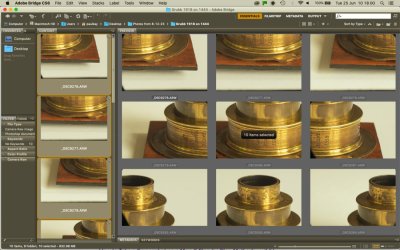
In a way, the digital camera is being used as a loupe. It can be moved into the corner of the image to test the resolution there.
I’m not sure how it deals with a curved image plane. Do you accept the curvature of the image as being a true representation of the most likely result of using film, or do you re-focus to discover the maximum performance of the lens at that point?
I’m not sure how it deals with a curved image plane. Do you accept the curvature of the image as being a true representation of the most likely result of using film, or do you re-focus to discover the maximum performance of the lens at that point?
- Joined
- Sep 25, 2017
- Messages
- 378
The digital camera is mounted so that it can be moved around in the image plane. 'Step & Repeat' images are taken to create a mosaic of the image projected by the large format barrel lens. These are then stitched. The end result can show the image from the lens as its designer intended. At the moment I can cover something around and slightly over 5" x 4" format, the limit being the lens throat of the digital camera which eventually 'shadows' part of the sensor as the periphery of the image is reached. I suspect that the Nikon EVFs will be best as they have the shortest flange to sensor distance so should create least shadowint (and a medium format digital back would be better still but at a higher cost obviously).
OK. Now I understand what you are doing but still don't see why. But then all our LF lenses were bought with the objective of obtaining the best possible image quality, with the aim of printing big, so we bought the latest available, with the least possible distortion.
A few years ago, we attended an LF conference in Bourges (here in France) and sat through an interminable lecture on "flare" with uncoated lenses, that raised the sound of snoring from multiple parts of the room. We were shown formulae and diagrams of lens geometry but no solution to the problem.
Several of us were of the firm opinion that the best solution was to junk such a lens and buy a coated lens instead.
But then, maybe, I am the kind of "Philistine" that can't see any point in "old and imperfect" gear like a Holga camera. If I really want an "antique" look to an image, I just resort to software to emulate it.
In fact, as digital sensor pixel density increases and resizing software becomes more accomplished, I find myself with less and less inclination to lug around a 15kg backpack and have to fight with dust spots.
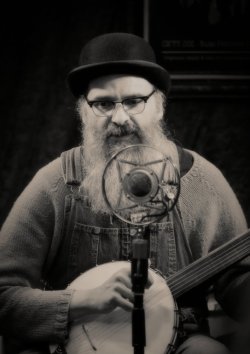
Here's an example of an "antique" portrait, taken with my Nikon D850, that will happily enlarge to 60" x 40"…
Not saying that I can't understand your love for the old and quirky - we have a Mamiya RZ67 and a Mamiya 7II camera and, occasionally, we get them out of the cupboard and stroke them lovingly - then think of all the faff processing, scanning and despotting the film and put them away again
Last edited:
I recently had a day out on a heritage railway and it was a delight. Generously sized seats and afternoon tea served at our table. When we stopped, everyone jumped out to admire the locomotive.
Despite all the enjoyment, if I had to travel from Penzance to Aberdeen, I’d choose a modern train, even with modern catering.
Does this remind anyone here of discussions about old lenses?
Despite all the enjoyment, if I had to travel from Penzance to Aberdeen, I’d choose a modern train, even with modern catering.
Does this remind anyone here of discussions about old lenses?
Flare was minimised in early lenses by having as few glass/air interfaces as possible, as in a simple doublet as Grubb designed, and by using enclosed designs like the 'pillbox' also as used by Grubb. We tend to think that in order to create technically acceptable images we need to use the 'latest and greatest' kit available. I'm far from convinced that this is as essential as we seem to think. Grubb was an early adopter of ray tracing and whilst he did this using large sheets of paper, it is essentially how lenses are designed today. Have we moved on as far as we think?
- Joined
- Dec 19, 2017
- Messages
- 3,501
I recently had a day out on a heritage railway and it was a delight. Generously sized seats and afternoon tea served at our table. When we stopped, everyone jumped out to admire the locomotive.
Despite all the enjoyment, if I had to travel from Penzance to Aberdeen, I’d choose a modern train, even with modern catering.
Does this remind anyone here of discussions about old lenses?
OK not so far but in my youth my father and I would take the train from Snow Hill, Birmingham, to Dundee. Those corridor trains with compartments were far more friendly, you knew everyone in the compartment by the time you arrived. Oh and the excitement of the banking engine to take us over Shap
I think a reply to Joanne, and a discussion, in a separate thread on old lenses would be more appropriate. I did once believe on having the best modern lenses. Then out of necessity used an older uncoated lens, but let's take that to a new thread.
Ian