FomaPan 200 5x4 & HC-110

I think you're right to meter for the shadows on zone 4. That's what I would do. They could do with a lift, the highlights also could go up although I see you will control them with a 20% cut in dev. It will be interesting to see.
 
Surely, placing the nominally Zone 3 shadows on Zone 4 is the same as using an EI that's one stop lower. By using a lower EI, you won't need to carry a different set of metering procedures in your head, for each film you might use. This will reduce your opportunities for error. LF photography offers quite enough opportunities already, without adding another one.

Anyone addicted to transmission densitometry readings of their negatives should ignore this. My concern is with making pictures, not hitting numerical targets.
 
For me, I set the meter ISO to what I have tested to be 0.1 above film base and fog for a particular film and leave it dialled into the meter when using that film. I meter the most important shadow detail and usually place it on Z3 and if I need to move it up a Zone I just his the ISO 2 on the Sekonic meter which I have programmed to be 1 stop more exposure.
 
Yes indeed. I'm familiar with that.
But Zones are not negative densities at all; they are print densities. If your 0.1 figure doesn't give you the print densities you want, which seems to be the case here, then 0.1 is wrong. What you are after is not absolute negative density but printable density and printable contrast.
I know there's a huge body of work from people who enjoy recreational densitometry, and I've read some of it. I'm not convinced. It seems so much easier to set the EI for the actual process of making pictures in the wild. The Zone System is sensitometry reduced to a few easily-remembered numbers, for use in field conditions, not Holy Writ or a puzzle to be solved. It seems wanton to make it more complicated again.
In my view, Zone testing should relate to the print. Why else would anyone do it? Does anyone exhibit negatives?
Perhaps I should add that this my private view. I don't insist on anybody following my advice.
 
David, I agree with you. In practice the Zone System is about matching negatives to one paper grade (where possible) rather than dogmatic densitometry.

This is how the Zone System has been taught in the UK for many years going back to the 1970's, as a system of practical tests first to determine effective film speed and then development times for normal lighting conditions - termed N. Finally by extrapolation and practice EIs and development times for extremes of lighting.

There's no magic it's just a method of measuring and determining the old adage "Expose for the Shadows, Develop for the Highlights".

I suspect the issues here where there's clearly under-exposure of the shadows are partially due to Foma films reciprocity, I'd guess the shadow areas are a couple of stops less exposed than expected, and extra exposure and cutting development might help. Perhaps not the most suitable film for the occasion.

Ian
 
Yes. I've been using some Fomapan recently (after a spell of HP5) and I certainly find something like this. If it wasn't for the economics, would we use it?

It's quite a while since I did any darkroom printing (although I still have all the kit) but the development of split-grade printing seems to have altered the printing landscape considerably. When I stopped wet printing, the practice was still to establish the "right" grade for each print and reserve the extreme filters for remedial action, perhaps to perk up the shadows or control bright clouds.
 
I've used a lot of 120 Fomapan 100 & 200 and had excellent results, I tend to not use it for my main projects. I have quite a bit of 5"x4" and 7"x5", also some 9x12cm Fomapan sheet film 100 & 200.

Over the past 30_ years a;most all my negatives print around Gd2 to Gd 3, in fact when I used graded paper I rarely sued Gd1 or 4, all the negatives scan easily.

There's an LF photographer who lives the other end of the county from me, an ex Ilford employee (when the company was still in Essex), he no longer wet prints but deliberately produces flatter negatives for scanning. He was doing a lot of interiors of buildings last time we met.

Back to Foma films the issue is they tend to build up density quickly during development faster than any other film I've used, consequently there's a bit more of a learning curve needed to get the best from them in more extreme conditions.. I did do some practical tests for reciprocity a decade ago and found it wasn't as bad as Foma's chart. It's time I bought some more 120 Fomapan 200.

Back to testing for cost reasons I've always done initial speed/development tests using 35mm film, with Foma it was 120. The advantage of 35mm is it's easy to make a series of negatives at 1 or ½ a stop exposure intervals to get an Effective EI then fine tune with development. I think this sort of approach might be useful for interiors like this church.

Ian
 
I would have thought that what were are looking for is some critical level of contrast at the foot of the curve and hence the point where the slope reaches a corresponding angle, rather than a prescribed density. Somewhere in my memory is the idea that Ilford have used this instead of fb+f. Clearly, it would be more laborious to establish than a single figure for density. (Well, two figures really – fb+f and the magical 0.01.) That 0.01 figure is suspiciously round, isn't it?
 
Ilford no longer use just densitometry to determine Exposure Index recommendations, "It should be noted that the exposure index (EI) range recommended for FP4 Plus is based on a practical evaluation of film speed and is not based on foot speed, as is the ISO standard".

In the past Ilford used the gradient or Contrast Index and published figures. The issue here is lack of density in the shadows but very intense highlights and a film prone to high contarast. There is a need for increased exposure and a cut in development, then in printing a higher grade of paper and controlling the highlights by flashing. Split Grade printing would be another option.

Ian
 
There is a need for increased exposure and a cut in development, then in printing a higher grade of paper and controlling the highlights by flashing. Split Grade printing would be another option.

Is the higher grade to compensate for the lack of separation in the midtones which could be a result of the reduced development time
 
It's to boost shadow an mid tone contrast, and the flashing is to reduce highlight contrast and has minimal effect on the mid tones and will be almost undetectable in the shadow areas.

There are cases where strict Zone System exposure and development controls are not enough to get the best froma scene, and this is where experience comes in.

Ian
 
I think this is a situation where you need a film that is inherently low in contrast and a compensating developer, one that will slow down in the highlights but still keep working in the shadows and mid-tones.

Each to their own, but I would choose HP5+ and develop it in ID11 1+2 for 14 minutes, or use a dilution of 1+3 for extreme contrast. This is reduced development, i.e. less than N development. To avoid the risk of mid-tones coming out too dark because of reduced development I would give extra exposure, i.e. expose the film at 200 instead of my normal 400.

As for working out an exposure, I would seek out the darkest area of the subject where I wanted a hint of detail to appear (a Zone111 area). take a spot reading from this and stop down 2 stops.

With sheet film we have the luxury of developing to suit the subject contrast. But the above approach has worked for me on numerous occasions when using a 35mm camera.

One typical occasion was at a craft festival on a day of intense sunlight. I photographed a pole-late worker in full sun, and in deep shade. a stonemason in open shade, and a potter in his studio with sunlight streaming I through a door and window. Film was HP5 rated at 200. Developer, ID11 at 1+2 14minutes at 20 degrees C.

The negatives varied quite a bit in contrast, but I made darkroom prints without too much trouble using filters from 1.5 for the most contrasty, to 3.5 for the frames that were lower in contrast.

I would put in a plea here for finding a film /developer combination and working method that delivers what you want, and stick with it. I have used the above combination in 35mm and 120 for years now. And only switched to Foma in 5x4 for cost reasons. But now I've finally used up my stock of 5x4 Foma, I have decided to hang the expense and go back to 5x4 HP5. I find HP5 and dilute ID11 easy to use, and utterly reliable.

It keeps life simple and delivers superb print quality. Apart from a weakness for FP4 in 35mm, developed in dilute Perceptol, I find I don't need anything else.

Alan
 
David, I agree with you. In practice the Zone System is about matching negatives to one paper grade (where possible) rather than dogmatic densitometry.

This is how the Zone System has been taught in the UK for many years going back to the 1970's, as a system of practical tests first to determine effective film speed and then development times for normal lighting conditions - termed N. Finally by extrapolation and practice EIs and development times for extremes of lighting.

There's no magic it's just a method of measuring and determining the old adage "Expose for the Shadows, Develop for the Highlights".

I suspect the issues here where there's clearly under-exposure of the shadows are partially due to Foma films reciprocity, I'd guess the shadow areas are a couple of stops less exposed than expected, and extra exposure and cutting development might help. Perhaps not the most suitable film for the occasion.

Ian
Hi Ian, I'm testing out Foma 200 with some long exposures and used a general scale tonight for reciprocity compensation. I don't think I've been nearly generous enough. Do you have any guides to hand for the 200? I'm also shooting coastal rocks and the stop difference between shadows and highlights (water) is no more than 2 stops, so ideally I'd like to stretch that out perhaps with extending dev. time? Any recommendations gratefully received. I'm erring towards Foma at this stage as I like the tones and don't require the sharpness of T-max 100.
 
Darren, I tested Fomapan 100 and later Fomapan 200 prctically using 120 film for reciprocity, I shoot both at half box speed which in itself makes a difference. I tested at 1 second and 10 seconds and found they needed 1/3 stop extra at 1 second and a stop at 10 seconds.

I'd suggest some tests with a roll of 35mm Fomapan 200, it's cheaper than wasting quite a few sheets of 5x4 :D The way I've tested in the past is make some bracketed exposures, take the camera into the darkroom cut that section of film off and process, based on the results do the same adjusying development, until nailing the required EI, Dev time and Reciprocity adjustments.
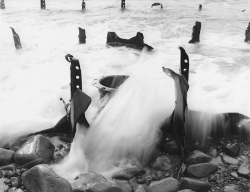
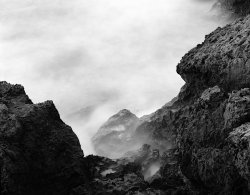
1616484609894.png

While this was 120 Tmax100 there was no need for any adjustments, metering highlights in water is difficult as exposures of 1 second or longer of moving water have a lot os specular highlights.

Ian
 
That's great thanks Ian. I can work on doubling 10 seconds to 20 and proceed from there. Yes, T-max is entirely different with reciprocity.
 
This was from a couple of days go. 45 seconds extended to 1 min. 25 seconds to allow for reciprocity. Neg was a tad thin but shadow detail present in all areas. Often, in these cases it's not always about revealing detail in all areas of the image although good to have as an option, hence the need to optimum exposure.
 

Attachments

  • Image (263)b copy.jpg
    Image (263)b copy.jpg
    171.7 KB · Views: 15
Back
Top