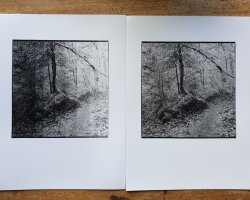
Gene Nocon explains B/W ƒ/stop Printing

that's one of the most important video I've seen regarding darkroom enlarging.
After that I downloaded f-stop printing calculator app on my android cellphone and use it very often.
 
"It's not where you point the camera."
?
 
I missed that David. But I must confess that I'd had enough of him after five minutes, and turned him off.

Alan
 
You missed seeing how Tiger Woods plays tennis.
This is a curiously amateurish film. As it's ten years old, I wonder if we've been spoiled by the higher quality of blogs from people like Thomas Heaton or Ben Horne. (...and they are made outdoors, on beaches and mountain tops.)
If people like to use his system, I don't want to discourage them, but I've found that 4,8,12,16... secs is as useful as 5,10,20,40... I do admit the logic, but in both cases it seems to come down to: "A little bit nearer to this or a little bit nearer to that?"
I believe there are devices that incorporate a meter, which will decide both paper grade and exposure time. Does anyone know about such a thing?

And is it true that you can't use flashing on Multigrade? Perhaps there were problems when the film was made.
 
I am disgusted that he tries to lay claim to the f-stop method of doing the first test strip. :mad: In the 1950's, when I first entered a darkroom, the 2sec, 4sec, 8sec, 16sec etc method of producing the first test strip was the standard method every one was taught and used as far as I was aware and it was taught to me by a guy who was printing this way before WWII. I've no doubt GN invented the physical f-stop timer but that was just to automate the process and a welcome one no doubt to those wealthy enough to afford the device.

I didn't watch the video all the was through as the noise from the trumpet he was blowing became too much. :eek:
 
At the beginning of the interview Mr Nocon seemed rather put out and disconcerted by the fact that darkroom printers use a variety of different strategies instead of all following the same prescribed method. He claims that this is why he came up with the fstop method. But why shouldn't we employ a variety of strategies? Printing is a creative process. You can't do it properly by following a set of rules Each of us do what we think works best for the negative in the enlarger, and the kind of print we want to produce.
I suspect that what he really wanted was for us all to adopt his method and, in the process, buy his FStop Timer and make him a rich man.
Good luck to anyone who uses an FStop timer, I'm sure the method works. But I've never gone for one. I like to keep things as simple as possible. And I don't like being tied down to one method.

Alan
 
What we'd really like is an introduction to his bank manger. (If you got that far.)
 
Here is a link to the RH Designs version of the timer. (The page mentions Mr Nocon.)
If you scroll down you can see an example of a test strip produced by the olde-worlde equal-step method, as used by unknown has-beens like Ansel Adams, and another one demonstrating how much better the the f-stop multiplication system is.
You may think, as I do, that the two examples look remarkably similar. You might care to guess which is which before reading the text.

http://www.rhdesigns.co.uk/darkroom/

Oops!
http://www.rhdesigns.co.uk/darkroom/html/f-stop_printing.html
 
Last edited:
I am disgusted that he tries to lay claim to the f-stop method of doing the first test strip. :mad: In the 1950's, when I first entered a darkroom, the 2sec, 4sec, 8sec, 16sec etc method of producing the first test strip was the standard method every one was taught and used as far as I was aware and it was taught to me by a guy who was printing this way before WWII. I've no doubt GN invented the physical f-stop timer but that was just to automate the process and a welcome one no doubt to those wealthy enough to afford the device.

I didn't watch the video all the was through as the noise from the trumpet he was blowing became too much. :eek:

I agree Keith, I thought in f stops in the 1960's, I always have I just don't call my way of printing F stop printing.

It's full of crap, people still flash to bring out highlights even with MG paper.

Ian
 
Egads (does anyone remember that?) but these posts have been worth the read.... Sometimes i can just look at the easel and have a good idea of the time needed but far from always, but then i often do things the hard way.
 
Joe, if you wanted the easy way, you wouldn't be here at all.
 
https://www.digitaltruth.com/apps/f-stop/

After having seen the video I searched a cheap way to get f-stop values on my timer. I found the app and tested it many times.
I normally start with calibrating my paper to my darkroom meter, Hauck Trialux. Getting the "Paper ISO" I can measure each negativ and make prints 95% without test strips. This helps using 35mm films.
If I than look to those worksheets I'm often able to say well this needs a f-stop more or less. Doing it in seconds is never the same, I have to find the f-stop values and I don't want to change the f-stop on the enlarger sense.
This is not scientific, it's much more a feeling but it works fine.
The perfect print of course needs a little more of that all but for those hundreds of worksheets ;) it has changed my way of printing and I hope I can somewhen find a f-stop timer for "cheap".
mp-photos.jpg
 
If only someone would come up with a bluetooth-linked timer, controlled by an iPhone app. The front-facing camera could function as a printing meter. Not my area of expertise, even if I had one.
 
I have to come back on this.

Lately I found a perfect App for doing this with a wifi relay.


Did you heard of this before?

I could do it with a Sonoff mini, and even being not the best person for doing such software hacks I could make it working.

f-stop example.jpg
 
Here is a link to the RH Designs version of the timer. (The page mentions Mr Nocon.)
If you scroll down you can see an example of a test strip produced by the olde-worlde equal-step method, as used by unknown has-beens like Ansel Adams, and another one demonstrating how much better the the f-stop multiplication system is.
You may think, as I do, that the two examples look remarkably similar. You might care to guess which is which before reading the text.

http://www.rhdesigns.co.uk/darkroom/

Oops!
http://www.rhdesigns.co.uk/darkroom/html/f-stop_printing.html
This page has helped me understand this concept more clearly than Nocon’s book. For me the most confusing thing was the name. I am now thinking of it as ‘doubling’.
I am used to measuring exposure, apertures and film speeds this way so, until a better name comes along, this is more consistent. The enlarger uses the same triad as the camera to control light from the enlarger. This method is still a metric for exposure, measured in time and using a more appropriate scale.
 
The f-stop system does sound very logical.
My point was that if you are using test-strips, the actual numbers don’t matter at all, as long as you know what they are and can refer them back to the test strip. Although it would be rather silly, you could even use random numbers and still extract the information you need. Don’t try this at home.
However, there may be more to it than just estimating exposures. I believe that the f-stop system is useful when scaling print sizes up or down. There may be even more advantages.
I did meet Mr Nocon once, but we spent most of our time discussing print cropping and how to deal with diagonals at the corner of a print. Should they be aimed directly into the apex, or should they be judiciously offset and by how much?
 
There was indeed a Nocon timer that did a good deal of the arithmetical heavy lifting. Can’t see any objection to making life easier.
As for pushing a button, show me a printer who doesn’t press a button, whatever method they favour.
 
There was indeed a Nocon timer that did a good deal of the arithmetical heavy lifting. Can’t see any objection to making life easier.
As for pushing a button, show me a printer who doesn’t press a button, whatever method they favour.
I've got a Gene Nocon timer somewhere.
 
Back
Top