Where does modern digital LF start?

I am wondering if the telltale pale halo around the trees on the horizon

Actually, there are no halos because there are no masks and, if anything, I had to reduce any apparent sharpening, that came from the trees being strongly lit on one side. The low side light really was extraordinary, which is why I took the shot.
 
Yipes! I am well aware of that technique and, not being a fan of spending hours in front of Photoshop, I would definitely avoid it.
When I tried stitching I used Microsoft ICE (a free download at least at that time it was several years back)
While I only stitched a maximum of 10 shots, it was remarkably quick for my time in front of the PC, and IIRC never more than a few hours of number crunching on the now ancient (2010) laptop. However merging multiple rows might add quite a bit to the difficulty & I have no plans to try managing LF this way;

FWIW I don't think I've totaled as much as an hour using photoshop :)
 
I must be imagining that clearly visible halo effect all along the horizon then, that isn’t present on the raw image.
 
Fascinating. And yet others elsewhere are complimentary about it. On what are you basing your dislike?
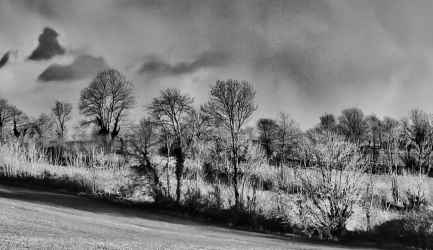
Everything is totally overdone. The big cloud looks far too smooth and lacking in natural textures. Totally unconvincing. The contrast level of the two rows of trees is far too high. You have reduced almost everything to, literally, black and white, and it just looks plain wrong. There are some weird dark shapes in the sky just above the horizon on the left side. They look really odd - a mess. You have cropped the foreground off, and this has created an imbalance in the composition at bottom right. I could go on, but I've had enough. Frankly, you ought to be able to see these things yourself....
 
I must be imagining that clearly visible halo effect all along the horizon then, that isn’t present on the raw image

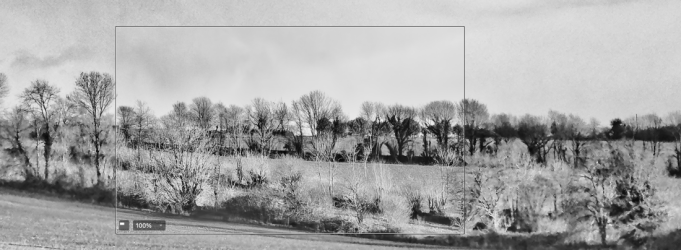
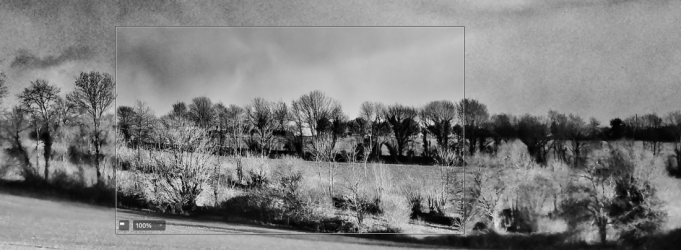
Upon investigation, that seems to be due to the global red filter accentuating the contrast. Here are two screenshots at 100% magnification (the inner rectangle is the noise reduced preview) taken from PhotoLab:

Without red filter…

Capture d’écran 2025-03-09 à 19.08.12.png

With red filter…

Capture d’écran 2025-03-09 à 19.08.03.png

Everything is totally overdone

With the intent of invoking a sense of foreboding.

The contrast level of the two rows of trees is far too high

That is mainly because of the strong light on one side of the trunks and is far less evident at a larger print size

There are some weird dark shapes in the sky just above the horizon on the left side

These are backlit clouds, which do look weird but are in keeping with the look and feel I was wanting to achieve.

Finally, here is a 100% screenshot from the finished exported TIFF, horrendously mangled by the forum software…

Capture d’écran 2025-03-09 à 19.13.24.png

Now, you personally may not like the result but it is how I envisaged it would end up before pressing the shutter and that was the point of the comparison, not whether the whole world agreed with my interpretation ;)
 
Several observations:

  • The critiques I have witnessed and experienced on this forum tend to favor lower contrast execution and disfavor higher contrast
  • Monitors do not agree, so a certain amount of grace should be given that what we see in duplication isn't necessarily what the original looks like
  • Tastes vary widely - no one of us has "correct" taste

To my "taste" (and that's all it is, it's not a severe criticism in any way), this image feels somewhat overproduced. It creates genuine visual drama to the detriment of visual believability. This is reinforced by what I find to be odd compositional choices. HOWEVER, artists make choices that suit them, not their viewers and so my view is that if @Joanna Carter loves this images, that is sufficient to call it "good".
 
(the inner rectangle is the noise reduced preview) taken from PhotoLab:
Why are you even having to use some software noise removal from a camera which has such a good signal to noie ratio to start with even in the top end ISO settings.

If this is AI driven noise removal, then as you are a Beta Tester for Topaz, I would be submitting a report to them
 
Several observations:

  • The critiques I have witnessed and experienced on this forum tend to favor lower contrast execution and disfavor higher contrast
  • Monitors do not agree, so a certain amount of grace should be given that what we see in duplication isn't necessarily what the original looks like
  • Tastes vary widely - no one of us has "correct" taste

To my "taste" (and that's all it is, it's not a severe criticism in any way), this image feels somewhat overproduced. It creates genuine visual drama to the detriment of visual believability. This is reinforced by what I find to be odd compositional choices. HOWEVER, artists make choices that suit them, not their viewers and so my view is that if @Joanna Carter loves this images, that is sufficient to call it "good".

Thank you so kindly. I don't often do as dramatic as this. I have seen plenty of LF film images end up as "soot and whitewash" and, as I have mentioned, the point of showing this image was purely to demonstrate that, just like a film negative, RAW images often look nothing like their finished versions.
 
Why are you even having to use some software noise removal from a camera which has such a good signal to noie ratio to start with even in the top end ISO settings.

Because this was taken at 4000 ISO, which limits the DR to only 10 stops and gives an SNR of only about 29 instead of 45 at 100 ISO

If this is AI driven noise removal, then as you are a Beta Tester for Topaz, I would be submitting a report to them

I do not use Topaz for NR, much preferring to use PhotoLab, which executes it at the deRAWitising(?) stage and, from my tests is superior to Topaz. Only the part of the screenshot within the inner rectangle is noise reduced but, even then, that is only a preview and not the final result.

Like I keep on saying, you really need to see the large print to appreciate the quality (if not the subject matter :rolleyes: )
 
I'm not interested in critiquing this image, of Joanna's.

Last time I made comments about images, a quick cut and paste and the Auto correct (2 or 3 times) showed that it was highly likely the originals were far better than those presented.

But why are we discussing heavy Digital manipulation at all on a Film based Forum.

Ian
 
Last edited:
Phewww!!!


Because this particular section is for anything related to photography. Look at the section title.

This thread baffled me as its more geared towards digital rather than film.
Its obvious the title of the section has led to some confusion so I have tried to rectify that to prevent further confusion.

I have also added some brief Forum FAQ's for anyone who may also be confused.

 
Phewww!!!

It's rare I critique an image, or series of images. Ultimately, that's the photographer's choice, but occasionally things just don't work, and the results are awful. While I'm sure I did comment on your images in the past, that was minor nit-picking

When I do make major criticism, I don't take fools lightly, particularly if they claim to be masters of their craft. That is so rare I think it has only happened once, and that is very recently.

When you go on workshops with leading photographers, or do a Masters, you learn to be self-critical, your own hardest critique, because that is how you learn and move forward.

I'm not aiming at you Joanna, or the workshops you have lead, they were honest and quite different, and you never made them out to be anything more.

But sometimes people need calling out. It amazed me that I could cut & paste a series of images into Image Editing software and then use Auto Correct 2 or 3 times and find that the base images were probably way better by a huge amount, compared to the poor images posted.

This is where you have to touch a baseline, we don't all have to choose the same. In my case, as a few here know & have seen prints, that's John Blakemore & Fay Godwin, also Peter Cattrell. That doesn't mean working exactly as they did, or printing in their style, rather evolving your own personal approach.

Ian
 
Surely large format is defined by the lens used to take the photograph? Its all about coverage. What you do with the negative/slide/digital file is up to you, but if the original image is projected by a lens with large coverage then the image must be a large format one. In the early days of photography it was the coverage of the lens which dictated the print size. So a 10" x 8" print would have been accepted as being large and things then progressed.
 
Just goes to show, no amount of effort can salvage a mediocre original.

Speaking from experience, here! :)
 
Surely large format is defined by the lens used to take the photograph? Its all about coverage. What you do with the negative/slide/digital file is up to you, but if the original image is projected by a lens with large coverage then the image must be a large format one. In the early days of photography it was the coverage of the lens which dictated the print size. So a 10" x 8" print would have been accepted as being large and things then progressed.
The coverage that's recorded perhaps, but not just the coverage of the lens.
One of my earliest lenses is a petzval style projection lens. I got it before I had a LF camera & so adapted it to digital to try out. When used on my old APSC DSLR the shots were definitely not LF, though I have since confirmed the lens does cover 5x4" even if it doesn't have much spare for movements.
 
The coverage that's recorded perhaps, but not just the coverage of the lens.
I use numerous old lenses. You can obviously use them all on 35mm full frame but then they aren't being used as intended. As examples I have a number of 'wide-angles' (angles not as wide as today's) and they are only 'wide' lenses if used as intended on their original format. Back in the early days to some extent the focal length of many lenses effectively dictated the format, well to some degree anyway. This changed as optics became more understood. So yes, its the coverage and the coverage dictates the original use of the lens and consequently the format.

On the subject of scanning, I copy film and plates using a digital camera. If I want larger files I simply copy in sections and merge them in software. Print size, whilst dictated by file size, is not dictated by format because its perfectly possible to go on enlarging a 35mm slide until the grain of the film is very obvious. The format is still 35mm though.
 
So, are you critiquing or not?

Whether you like the processed image is not the question, or even the subject of this discussion. Personally, I would not place any value at all on your opinion, as I don't see why you feel the need to be so unpleasant.

Ignoring the fact that this was a digital image, my point was to demonstrate that, whether it be digital or film, the printed image can end up bearing absolutely no resemblance to the negative or RAW file.

Sticking to LF film, take Ansel Adams' famous Moonrise Hernandez image. He printed it several different ways, ending with a sky that was a lot darker than the original negative; as he also did with his Half Dome image. Why? Because he interpreted what he saw and initially captured, to convey what he was feeling and that interpretation changed over the years.

To criticise what you perceive as my lack of processing skill is in error, as I processed it deliberately to come out the way it has. I could have processed it to come in any number of different ways but this was my current predilection. That may change over time.

I don't mind that you don't like it, but that doesn't mean your opinion is right. So, let's just agree to disagree and move on.
 
"....................... So, let's just agree to disagree and move on.........."

Thank God for that! :D :D
 
Surely large format is defined by the lens used to take the photograph?

That's an interesting notion but… I can put something like this adapter on the back of a view camera and use a digital camera to "scan" the scene, giving a 5" x 4" composite image with no negative.

What you do with the negative/slide/digital file is up to you, but if the original image is projected by a lens with large coverage then the image must be a large format one

Unfortunately, the owner of this forum, along with several members, would deem it sacrilege because it is mandated that film and only film can be used to take the image, even if the first thing you do with the neg is to scan it or, heaven forfend, to digitise the 5" x 4" neg on a light box with a digital camera.

Where do LF folks go for advice and discussion on this kind of hybrid process?
 
Back
Top