Kodak D-76 With No Hydroquinone

Ian-Barber

Admin
Registered User
Joined
Aug 6, 2016
Messages
1,723
@Ian Grant may know the answer.
Are there any drawbacks to not including Hydroquinone in this formula? I know it says it's more stable but it doesn't mention why.

Darkroom Cookbook Third edition FORMULA #19

D-76H

(Grant Haist)
This formula is indistinguishable from Kodak D-76 and can be used in exactly the same way, including the same development times. It has the advantage of costing less to make, being more “environmentally friendly,” and being more stable than D-76.

Water at 125F/52C, 750.0 ml
Metol, 2.5 g
Sodium sulfite, 100.0 g
Borax, 2.0 g
Water to make 1.0 litre
Use as you would D-76.
 
Last edited:
D76h contains Hydroquinone, according to Eastman Kodak Research publications.

This developer should really be called H76 (as it is not a Kodak developer) it was suggested to Bill Troop by Grant Haist, Kodak Research's first Fine Grain Developer was published a year before D76

Eastman Kodak Research Fine Grain Developer (1926)

Metol, 2 g
Sodium sulphite, (anhyd), 100.0 g
Borax, 2.0 g
Water to make 1.6 litre

H76 is not eally more stable than D76, the instability of D76 is really due to bromide build up when it's replenished.

Like D23 the downside is both give lower contrast results, compared to D76, so aren't so good when lighting is flatter. Ansel Adams recommended D23 when there was a vere long subject brightness range..

In terms of beeing envirmental friendly the best developesr are those replenished, these days that would be Xtol, unless you mix your own. The major reason for issues with Hydroquinone has been it's use as as a skin lightner, which is why the EU would like to ban it.

Ian
 
So if I have read you right, mixing the above without the Hydroquinone is not really going to give significant differences over D23
 
D23 will be slightly lower contrast as it has no Borax but 3x the Metol. H76 will be close to D76 for Normal use but not as good for N+1, N+2 etc. Effective film speed will be slightly less as well, probably 1/3 of a stop. H76 would be slightly better than D23

Ian
 
D23 will be slightly lower contrast as it has no Borax but 3x the Metol. H76 will be close to D76 for Normal use but not as good for N+1, N+2 etc. Effective film speed will be slightly less as well, probably 1/3 of a stop. H76 would be slightly better than D23

Thanks, I don't have any Hydroquinone but do have the other chemicals so I might see if I can get some which would get me closer to the D-76 formula
 
D23 will be slightly lower contrast as it has no Borax but 3x the Metol. H76 will be close to D76 for Normal use but not as good for N+1, N+2 etc. Effective film speed will be slightly less as well, probably 1/3 of a stop. H76 would be slightly better than D23

Ian

Per our recent D-23 fiddling prodded by @Ian-Barber and aided and abetted by @Raghu Kuvempunagar ... Couldn't the H76 be juiced with a little lye to make it more active and provide more contrast? I ask because I'm not entirely clear what the relationship between increased alkalinity and effective contrast might be.
 
Increased alkalinity with increase developer activity, the whole pointof D23 is its low akalininty cuased bythe Suplite, D25 lowers this further by adding Metabisulphite.

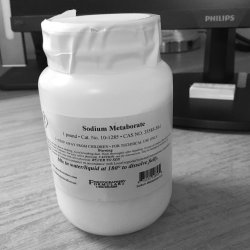
DK76b is the Eastman Kodak Research Fine Grain Developer with the Borax replace with Sodium Metaborate, and they have increased the concentration.

DK76b


Metol, 2 g
Sodium sulphite, (anhyd), 100.0 g
Sodium Metaborate, 2.0 g
Water to make 1 litre

You would have to make up a solution of Sodium Metaborate, from Borax & Sodium Hydroxide, as it is not available in Europe.

Crabtree & Henn did extensive research over at least 17 years, starting with the EK Research Fine Grain Developer leading to the introduction of D76, D23 & D25 were a spin off on the way to the introduction of Microdol, and then Microdol-X

Ian
 
No, the only commercial products from that direction were D76, then years later DK20 - sold as Kopdatol here in the UK, DK20 replaced the Metabisulphite in D25 with Sodiun Tiocyanate and switched to Metaborate. Later DK20 was replaced byMicrodol which is D25 but instead of Metabisulphite included Sodium Chloride. They are all in the same research papers.

D23 and more so D25 were designed to be finer raine= than D76, D25 in the Ultra/Sper Fine Grain category, but lowering the pH (less alkaline) affects film speed, Kodak decided to use Thiocyanate as tha gave the finest grain.

When DK20/Kodatol was release initially there were no issues, but soon there were issues of Dichroic fogging with Eastman Kodak films, it didn't affect the same films made by Kodak UK, and its subsiduary Kodak Canada, or Ilford and Agfa films. So Eastman Kodak went back to their pre-WWII research and introduce Microdol, replacing the Thoicyanate with 25g per litre Sodium Chloride.

Initially this solved their problems, but they returned, so they reformulated as Microdol_X. The issue turned out to be caused by radioactive fallout fom US atmospheric nuclaer tests in the US deserts. This had gradually affected the Sulphur sites of the active Gelatins used in film and paper emulsion. The situation needed drastic methods, Eastman Kodak devised a way ofstripping out the Sulphur sites from the Gelatin, which gave a Photographically (almost) inert "De-activated" gelatin.

All companies now use de-activated gelatin, and they can far more accurately modify the gelatins to suit their needs by re-sulphurising with Sodium Thiosulphate. This meant that suddenly Kodak films made in the UK were indistinguishable from those in the US. When I began darkroom work seriously in 1968 some Kodak developers gave different times and the suggested EI's for EK Tri-X, Canadian Tri-X and Kodak Ltd Tri-X, and they were significantly different.

Ian

Have you ever come across a canonically correct formula for Microdol-X?
 
Adox are currently selling a version of D76 which contains hydroquinone, but is free from borates. The MSDS lists metol, sodium sulphite, sodium metabisulphite and hydroquinone only. I am wondering if the sulphite is the accelerator in this product like it is with D23?
 
Back
Top