Measuring Developer Quantity

Ian-Barber

Admin
Registered User
Joined
Aug 6, 2016
Messages
1,723
Can we use the same principle when measuring out developers as we can water?

Ig of measured water = 1ml
10g of measured water = 10ml and so on.

So can we use that same principle when measuring out developer, say 4g of pyrocat A = 4ml or do we have to take into account the Specific Gravity of the developer?
 
You need in theory to take into account the Specific Gravity. But why not try measuring and weighing.

Ian
 
You need in theory to take into account the Specific Gravity. But why not try measuring and weighing?

Ian

Yea I will try that. The reason for asking is that I am fed up with the numbers rubbing off the syringes I have despite the fact they are not cheap ones
 
For the amounts of active agent in most developers, there should be very little significant difference, probably less than from variations in temperature. In any case, what counts is not minute accuracy, but consistency.
A piece of tape on the syringe might help.
 
Yea I will try that. The reason for asking is that I am fed up with the numbers rubbing off the syringes I have despite the fact they are not cheap ones
If the numbers rub off they are disposable syringes.
The non disposable syringes we have here are nearly all glass, (with the odd metal model, and a single very large volume plastic job).
Typically you could spend half an hour rubbing these with wire wool & still have the scale, (this might not be the case with the 1.5 litre syringe!)
 
|This might not be the case with the 1.5 litre syringe!)

If a nurse uses a 1.5 litre syringe you have problems . . . . . . . . . . . . . . .

I had the misfortune to, no we won't go into that except to say I was in the same hospital ward, it was visiting hour, all the visitors rapidly left. I was stuck on traction with a broken leg. It wasn't Roses . . . A bit like Diaper Don . . . . . .

On a more serious note I've been using the little measuring cylinders that came with Photocolor C41 and E6 kits for decades and haven't worn the calibration lines off yet.

Ian
Our 0.5 microlitre syringes aren't much use to nurses either :)
Nearly all our syringe requirements are for tiny samples no more than 0.1ml (and often 1/1000th of that) but we do have a range of gas tight syringes mainly 10ml & less. I've only used the big syringe for air samples.

For less demanding work we have disposable syringes too ranging from 1ml to 30ml. I've used some of these hundreds of times without the scales becoming unreadable. The Braun Injekt range are our most used disposables I think 100 syringes are under £20 for the sizes under 5ml (and they're even sterile if the nurse needs some spares)

When making up solutions our normal practice is to work by weight (or weight/volume) but I doubt many photographers have analytical balances available. Then they won't need to make up solutions to anything like the accuracy needed for analytical standards - normal digital kitchen scales should be quite good enough (0.1g resolution should be fine).
 
Last edited:
I have a glass calibrated syringe but have never used it. I have some plastic ones designed for refilling Inkjet cartridges, I can use if needed.

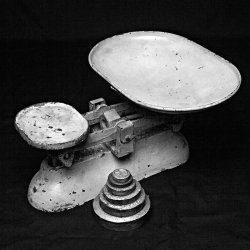
For Phenidone I have some digital scales that weigh to +/- 0.01g, they were cheap but are surprisingly accurate, I have a calibration weight. My Griffin & George balance can go to +/- 0.001g (in theory) but it's a pain compared to modern electronic scales.

Back around 1989 I paid over £4,000 for a set of Mettler scales, the maximum weight capacity wasn't very high, accuracy was to 5 decimal places, +/- 0.00001g, need when the typical sample size was 0.2g, we assayed precious metals. Now similar scales are over £10k.

Ian
The scales I use most (Sartorious) weigh to 4 decimal places & a max weight of 160g. They do have a lower range 30g max to 5 decimals, but I've not used that often. Even the second decimal is useless when we have a train shunting, despite an isolating slab - fortunately they don't shunt for more than half an hour. I don't know how much they cost but like you we've had them for over 20 years (now externally calibrated annually). I vaguely remember using mechanical scales like the Griffin & George, I wouldn't be keen on using them now (It's very different using a vintage camera!)

Such analytical instruments are total overkill for darkroom purposes ~£10 digital scales from amazon should be fine. Even without calibration they should be fairly repeatable. I suspect even the cheapest mechanical kitchen scales could be used without significant issues for darkroom chemicals. :)
 
I use a digital lab scale I bought years ago that alleges to be accurate to 0.1 gram up to 300 grams. It came with a 200g calibration weight. It does everything I need except handle very small amounts where .01g resolution could be needed.
 
You may already know this, but I was told that dissolving a known quantity in a known weight of water and then dividing the solution was a way to cheat with orders of magnitude.
I’ve never needed this level of precision. The fact that members can swap so many varied recipes suggests that the film is going to develop anyway, however much pedantry is employed.

This problem so rarely comes up that I've never bothered to get a higher resolution scale, at least with the chemistry I am currently mixing. I think this last happened when some formula I was trying out called for 7.5g Metol/litre. But I only wanted to make 500ml to try it out, hence mandating 3.75g of the stuff. So I just got it to 3.7g and "eyeballed" a little more.

These days, I just make a full litre of stock and save it in 2 500ml bottles for longevity.
 
I think this last happened when some formula I was trying out called for 7.5g Metol/litre. But I only wanted to make 500ml to try it out, hence mandating 3.75g of the stuff. So I just got it to 3.7g and "eyeballed" a little more.

Would this have been for trying out some D23
 
Would this have been for trying out some D23

It was not, but for the life of me I cannot recall exactly what I was trying to measure. I seem to recall it involving a small amount of Phenidone, not Metol, now that I rethink this.
 
You may already know this, but I was told that dissolving a known quantity in a known weight of water and then dividing the solution was a way to cheat with orders of magnitude.
I’ve never needed this level of precision. The fact that members can swap so many varied recipes suggests that the film is going to develop anyway, however much pedantry is employed.
'Serial dilution' like this, is frequently needed at my work where accurate standards of material diluted to parts per million or parts per billion is not uncommon. I doubt I'll ever have to use the technique for photography, but it is useful to know about if your scales are lower precision :)
 
May I indulge myself with some very niggly pedantry? With prior apologies of course.
I think you mean lower resolution, rather than lower precision. Any inaccuracy would persist in the dilution.
 
May I indulge myself with some very niggly pedantry? With prior apologies of course.
I think you mean lower resolution, rather than lower precision. Any inaccuracy would persist in the dilution.
Resolution would indeed be a better term, but inaccuracy is reduced by weighing larger amounts. Scales will often have a fixed error over much of their measuring range. 5g +/- 0.2g is less precise than 25g +/- 0.2g
This is even more noticeable when weighing near the resolution limit.

It's common for low precision sensors to be used in low resolution scales, but I suppose the converse is not always true high resolution scales may not have precision in any way matching their read out.
 
Very sensible. Thank you.
I recall when Britain finally adopted the metric system (although a lucky few of us could already count up to ten). Recipes were being published using the accurate conversion from ounces to grams - 28.3495 etc, which must have terrified the novice cake-maker. Happily we now use a convention of 1oz = 25g in the UK. Cakes seem equally delicious. US recipes remain a mystery, but US inhabitants seem to manage perfectly well.
 
Back
Top