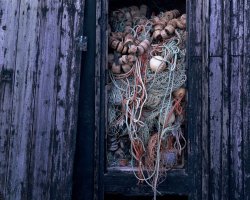
Dungeness Fisherman's hut

I like the colors, the light on the nets, and the contrast between the different textures.
The wall looks a bit purple: was is the case ?
 
Yes the colours are pretty accurate. I suspect the fishermen would use anything they could get cheap or free.
 
I really like this. A subject that intrigues me. I've spent a lot of time photographing, drawing and making paintings of fishermen's huts on the North Yorkshire coast.
 
Nice image. To me feels like it was made during the blue hour, just before darkness.
 
I really like this. A subject that intrigues me. I've spent a lot of time photographing, drawing and making paintings of fishermen's huts on the North Yorkshire coast.

I was unaware the the UK had dungeness. I have murdered many of these when I worked in the Alaskan fishery. I hadn't seen this thread before, but it brought back many happy memories.
 
I was unaware the the UK had dungeness. I have murdered many of these when I worked in the Alaskan fishery. I hadn't seen this thread before, but it brought back many happy memories.

The subject of the post is a place on the coast in Kent. It is not a crab
 
The subject of the post is a place on the coast in Kent. It is not a crab

Ah got it. In Alaska, a "dungeness" is a small, tasty crustacean much more afforable than the more famous King Crab.

We are indeed two peoples separated by a common language. Thanks for the clarification.
 
Can the figure f16.5 be a kind of shorthand for halfway between f16 and f22?
Being able to set an actual 16.5 would imply twelve index marks on the aperture-setting scale, which seems unlikely.
 
Can the figure f16.5 be a kind of shorthand for halfway between f16 and f22?
Being able to set an actual 16.5 would imply twelve index marks on the aperture-setting scale, which seems unlikely.

It's a quirk needed for Etkachrome 100es film, better known as a "Typo"

I have German lenses marked f4,5, 6.3. 9 13, 18 etc, f18 is a third of a stop down from f16,

Ian
 
Can the figure f16.5 be a kind of shorthand for halfway between f16 and f22?
Being able to set an actual 16.5 would imply twelve index marks on the aperture-setting scale, which seems unlikely.

I think the point is, exposure for shots like this is usually led by the aperture required for DoF. In this case, for the usual Copal shutter, with a minimum aperture of f/64, no need to allow for diffraction, you could quite easily use f/32.

I have German lenses marked f4,5, 6.3. 9 13, 18 etc, f18 is a third of a stop down from f16,

This will depend on the shutter, not the lens.
 
I just wondered thats all. Anyway, what matters is the end result and the Dungeness photo is a good 'un. Because I favour the "Group f/64" approach, that is total image sharpness, I use f/32 all the time and just adjust the exposure. It keeps things simple. Well it works for me.
 
This will depend on the shutter, not the lens.

Some early German barrel lenses used similar non-standard f-stop scales. Post WWII it's rare to see a non-standard scale and then only on shutters where the scale has been engraved later.

I just wondered thats all. Anyway, what matters is the end result and the Dungeness photo is a good 'un. Because I favour the "Group f/64" approach, that is total image sharpness, I use f/32 all the time and just adjust the exposure. It keeps things simple. Well it works for me.

A thread on this topic would be useful.

Ian
 
Can the figure f16.5 be a kind of shorthand for halfway between f16 and f22?
Being able to set an actual 16.5 would imply twelve index marks on the aperture-setting scale, which seems unlikely.
This is exactly how I would record an aperture between f16 and f22 even if "technically" that's incorrect.
 
Back
Top