De Vere Vericon 504

Flack

Popular Poster
Registered User
Joined
Dec 24, 2021
Messages
246
I got a De Vere Vericon bench enlarger early this year that had been completely overhauled and serviced, its in excellent condition. I have used it a couple of time since then to make prints. But most of my Darkroom printing is done in the darker winter months because my darkroom faces south so gets the sun all day, ( when we get some sun ) so it gets to hot then.
So now I am using it nearly every week trying it out with 6x6, 6x7, 6x9, and 4x5. I use my analyser pro with it and I am getting great results, its just so much easier to use then my old 45 year old Meopta Opemus 6, especially with the focusing wheels at the front making focus so much easier on a large print.

Anyway my question is for those who use this enlarger there are different sets of condensors, are these needed for different formats. Like I posted above the formats I have printed so far have come out great, so are these needed?. I have looked on the two condensors fitted but can not find any markings on them telling me which pair I have installed.
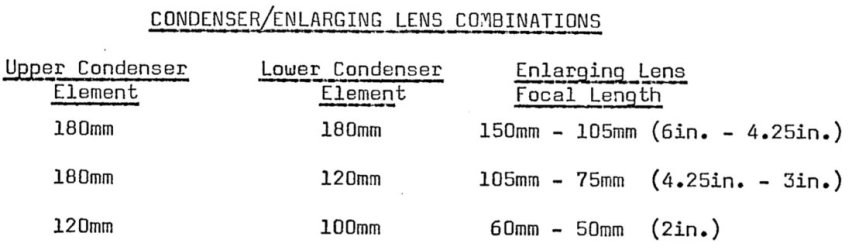
 
If you're happy with the results then there's no real need to change the set-up. I presume you have the document where this image comes from?

Screenshot_20241202_223545_Firefox.jpg
 
Hi MartyNL Yes I have seen this image on my condensor door, I assume the different condensors are for the focal length change, I have used a 150mm for 4x5 and my 80mm for 6x45,6x6,6x7,and 6x9 and had to me very good prints. I have the neg carrier for 35mm for the De Vere, but I dont do much 35mm printing now, and when I do I use my Meopta Opemus 6 for this format.
I am not after works of art I just like the darkroom processes, I find it relaxing and a way to switch off.
 
If it works, then follow Flack’s excellent advice.
The shorter focal lengths for smaller formats show that they create a smaller circle of light for the smaller formats. Otherwise, a good deal of the light would be wasted and printing times extended. It sounds as though you are not greatly concerned about very short exposure times anyway. For fine printing, longer times are probably an advantage.
When we see some sun, you could distinguish the focal lengths approximately by focusing on a piece of paper.
 
Hi Flack, I know some folk use just one diffuser box on their diffuser enlargers for all formats. Excess light gets masked off and any additional exposure time is accepted.

I didn't know that the same was even possible with condenser enlargers. I've never tried, as I have all of the elements and lenses, and just thought that each condenser set-up was specific to each lens and format.

I'm tempted to have a play now...
 
MartyNL I have also done from a 12x16 to a 5x7 with a 150mm, 135mm and a 80mm lens and not noticed any difference in spreading light, it all looks even to me.
 
It’s the condenser lens that makes the difference. If the condenser system projects a circle of light that will cover 5x4 then it will obviously cover smaller formats. If the shorter condenser lenses are used, they will project a smaller circle which may not cover the larger format adequately and give either vignetting or actual cut-off.
The projection lenses can’t see what’s going on above the negative, so they are a different matter, although their own image circles are significant too.
Some people use a longer focal length projection lens. They may simply like the way it renders the subject; they may possess only one lens and very occasionally print from smaller negs; or they may prefer having more space for extensive dodging and burning.
Others claim that a longer-than-normal projection lens uses only the centre of its optics and gives higher resolution, more even illumination or some other desirable result.
 
Back
Top