A Lye-r 's Tale: Dilutions Of Grandeur

You are part of any conversation you wish to join ;)


I do think that there is value in more formal, controlled testing when someone is first starting out. It gets one to at least passable negatives early on which then serves as a base for further exploration.

Once again I have to disagree. (Sorry!). When I did my formal, controlled testing it didn't get me to "at least passable negatives". It showed me exactly how to get the negatives that would produce the prints that I wanted. I was not a beginner. I was already getting results that I was quite happy with. And it did help that I had a clear idea about how I wanted my prints to look. The controlled testing simply fine-tuned things for me. I now have a very simple approach. No messing about trying this, then trying that. I now only use two films, in all formats, and two developers. And my focus is very much on what I want to photograph, not all the technical processing side of things.
 
Once again I have to disagree. (Sorry!). When I did my formal, controlled testing it didn't get me to "at least passable negatives". It showed me exactly how to get the negatives that would produce the prints that I wanted. I was not a beginner. I was already getting results that I was quite happy with. And it did help that I had a clear idea about how I wanted my prints to look. The controlled testing simply fine-tuned things for me. I now have a very simple approach. No messing about trying this, then trying that. I now only use two films, in all formats, and two developers. And my focus is very much on what I want to photograph, not all the technical processing side of things.

Don't be sorry :) Thoughtful disagreement is a path to better understanding.

I think the testing well is something one revisits as often- and as deeply as they feel the need. I may yet go back to more rigorous tests but current interest was much smaller and less ambitious. I do have a densitometer that I may need to go dust off :p

P.S. If you have examples of your Perceptol developed stuff your' be willing to share, I'd really enjoy a look.
 
@thronobulax so far with D23 and 35mm, what have you concluded that gives you the results you like? I am guessing it's going to be the 60min semi-stand.
 
@thronobulax so far with D23 and 35mm, what have you concluded that gives you the results you like? I am guessing it's going to be the 60min semi-stand.

Well, all the informal testing I documented above ("informal" means "not rigorous or complete or controlled") was with 60min semistand regardless of dilution or developer used.

I have developed 35mm in D-23 1:1 quite successfully in the past. I don't use it now, though, because - at the dilutions I use (1.5:1:200) - 35mm in Pyrocat-HD gives me noticeably better grain behavior. In fact, even if I highly dilute Pyrocat-HD with a nominally grainy film, I get surprisingly good performance.

For example, here is 35mm Tri-X, processed in Pyrocat-HD 1.5:1:300 for 60mins with EMA agitation:

https://www.tundraware.com/Photogra...ver/media/large/20220906-1-14-Lock-N-Rock.jpg

In most developers, Tri-X just looks "gritty" to me. Here is has - to my eye anyway - very smooth tonality.

Contrast that with D-23 1:9 Semistand with Kodak Double X, a film that is generally far less grainy and would normally be expected to also have good smooth tonality (also noted above):

https://www.tundraware.com/Photography/MyPhotographs/Silver/media/large/20230608-1-12-Tickets.jpg

In both cases, we're using a highly dilute version of the developer, but the Pyrocat-HD negative looks better, even though the film is inherently more grainy and even though the image in question was actually agitated more than the D-23 developed negative.

I'm inclined to conclude, therefore, that highly dilute D-23 so utterly reduces the solvent effect as to actually emphasize the grain of the film, where Pyrocat is actually masking the grain, likely because of staining effect.

But, at larger formats, this problem becomes a non-issue. Again from the top of this thread, here is 12x9cm in D-23 1:9:

https://www.tundraware.com/Photogra...ver/media/large/20230616-1-91-Barking_Mad.jpg

I find this image to be tack sharp with beautiful tonality.

The question is, can the sharpness of D-23 1:9 be achieved with Pyrocat-HD at some dilution and agitation discipline so as to also benefit from its staining properties and grain masking. To Be Continued ...
 
Last edited:
@thronobulax: do you have examples to share of Double X 35mm film developed in D-23 1+3?

I do not, unfortunately. I just got my first rolls of 35mm Double-X and have only developed one of them as noted above in D-23 1:9 ... which was pretty grainy. I suspect 1:3 would be better.

I have processed Double-X in 120 in Pyrocat 1.5:1:200 Semistand for 60 mins and gotten very good results.
 
@Raghu Kuvempunagar And now I have a question for you ;)

Have you ever tried D-23 1:9 without the lye? I wonder if it's really need for long (semi)stand type development where the highlights exhaust quickly and the shadows develop to completion with long time in developer.
 
@Raghu Kuvempunagar OK, well I just tried D-23 1+9 in 60min Semistand without- and then with lye added at 0.5g/l. Negatives are still drying but inspection suggests pretty strongly that:

  1. D-23 1+9 without lye will absolutely work. HOWEVER ...
  2. It appears to lose about 1/2+ stop of shadow speed
  3. It reduces overall contrast quite noticeably
  4. Adding the lye (i.e., Raising alkalinity) definitely makes the developer work more as one might expect. And it really works. I added the lye after I did the first test without it, so the developer had already been used for a couple sheets and had been sitting in the open tank for an hour, when I ran the test with the lye added for another hour.
This dilution without the lye might make sense in a really big SBR where you need to pull in the highlights a bunch, albeit at a loss of film speed. Thinking along the lines of N-2 give or take.
 
Last edited:
@thronobulax: I'm curious to know if you'll be doing tests to compare Pyrocat-HD and D-23 1+9 with lye. :)

Well ... maybe. Here's what I know about both so far just from ordinary use:

  • D-23 1+9+lye reliably develops in semistand with great sharpness and decent compensation effect.

  • I tend to favor 1.5:1:200 as my everyday Pyrocat-HD semistand practice. But, you can only dilute Pyrocat-HD so far (to try and get more acuity). At 1.5:1:300, it starts to show a loss of contrast. Keep in mind that Part B is the alkaline component of Pyrocat-HD so reducing it in final solution makes the developer less active, much like excluding lye does in the D-23 1+9 concoction.

    However, this is useful in very high SBR environments. For example, this image was handheld on 35mm Tri-X and developed with EMA at that higher dilution:


  • When I want to try for better sharpness, I switch from semistand to EMA AND higher dilution as I did above. This reigned in the SBR and still gave me decent contrast. The sharpness is less evident due to format and being handheld, I think. This more dilute/more frequent intermittent agitation is favored by people like Steve Sherman who want to accentuate edge effects.

  • Pyrocat-HD stain - at least at the dilutions I am using - seems to help control grain. In that sample image, even though it's a small format and Tri-X, the grain is surprisingly unremarkable.
The one thing I probably will still try to to shoot the same film/scene in a big SBR to directly compare the compensation effect of D-23 1+9+lye with Pyrocat at some higher dilution. It's unclear to me which of these compensates more aggressively. I also want to explore changing the ratio of parts A and B with Pyrocat to see if there is a useful "tuning" to be found.

At this point, Pyrocat-HD is my only go to for smaller formats and my default for larger formats until/unless I become convinced that D-23 actually offers something unique.
 
@Raghu Kuvempunagar Thanks to your help and input, I've nearly completed the lye testing cycle to allow for somewhat better direct comparisons.

Here are two images shot in the same location, at approximately the same time of day and lighting. Both were semistand developed - 2min initial agitation, stand, 15 sec agitation at 31min, stand, done at 60min.

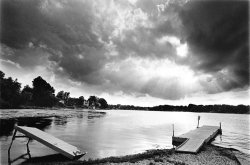
The first is DK-50 1:4 + 0.5g/l Lye - 9x6cm Agfapan APX 100
The second if D-23 1+9 0.5g/l Lye - 12x9cm Fomapan 100


I realize that there may be some variability of two different films and formats, however, to my eye at least, the D-23 1+9 holds the tonal range and manages the highlights better than the DK-50 at 1+4. I also find the D-23 image to have a more evident snap.

I don't think this is all attributable to the film type and size. Here's Acros II in 9x6cm in Pyrocat-HD with similarly delicate tonal management:


Per your prior request, I did expose some 35mm Double X and just processed it in Pyrocat-HD so we can directly compare it with the images I noted above for that film processed in D-23 1+9+Lye. Recall that those were quite grainy. These were shot yesterday in a high SBR environment with a lot of tree line detail, to really push the format to its edge. As soon as I have prints, I'll follow up here.
 
Last edited:

Attachments

  • 20230706-1-03-Channel_Lake-1.jpg
    20230706-1-03-Channel_Lake-1.jpg
    181.7 KB · Views: 11
@Raghu Kuvempunagar I wanted to do yet a bit more testing as I was unhappy with the results of the lakefront semistand image above. Again, the purpose here is further examine just how good/bad Double-X can be even in smaller formats - presumably 120 would be better still. But sadly, no 5x4 is available.

The following are Double-X 35mm handheld with Nikkor Ai-S 35mm f/1.4, EMA processed in Pyrocat-HD 1.5:1:250 open tank processing in 2l of developer. 3min initial prewash, 2min initial continuous agitation, 10sec agitations at 21min and 41min. Total time 60min. It seems that the EMA approach yields very well controlled SBR and terrific edge sharpness. A tripod and mirror lockup would no doubt have helped. Anyway, I thought you might find this interesting as well.

Scans of silver prints:

https://www.tundraware.com/Photogra.../large/20230825-1-05-Field_Of_Pipe_Dreams.jpg
https://www.tundraware.com/Photography/Gallery/Silver/media/large/20230825-1-09-Sewercide.jpg
https://www.tundraware.com/Photography/Gallery/Silver/media/large/20230825-1-18-Machinehead.jpg
https://www.tundraware.com/Photography/Gallery/Silver/media/large/20230825-1-23-Edgelord.jpg
https://www.tundraware.com/Photography/Gallery/Silver/media/large/20230825-1-25-Love_In_Vein.jpg
 
This is indeed interesting. TFS.

As you might be aware, Double X is now available in 120 format, a little expensive though. I doubt it will be ever available in sheet format, but who knows what is in store for the future.
 
Back
Top